Best ever cocoa brownies

Unbelievably it’s been a year since I’ve written up a recipe. That’s sad. Ah well- here is a tried and true favorite for my comeback.

Alice Medrich is brilliant and everyone should buy Bittersweet. Her recipe is super forgiving and I’ve made it easier (microwave rather than double boiler) and I’ve replaced APF with whole wheat pastry flour (nuttier and yummier and I’ve forgotten which blog recommended that substitution)With all due respect to the master, I like my recipe more.

Firstly- oven on at 325F

Second – chop 2/3 cup of walnuts to bits (as small as you’d like) and microwave them in 30 sec installments till you start smelling the oils. If you can smell them, they are toasted just enough. Let them cool

Third- melt 10 tbsp of butter in the microwave. Cover the bowl, the butter will sputter.

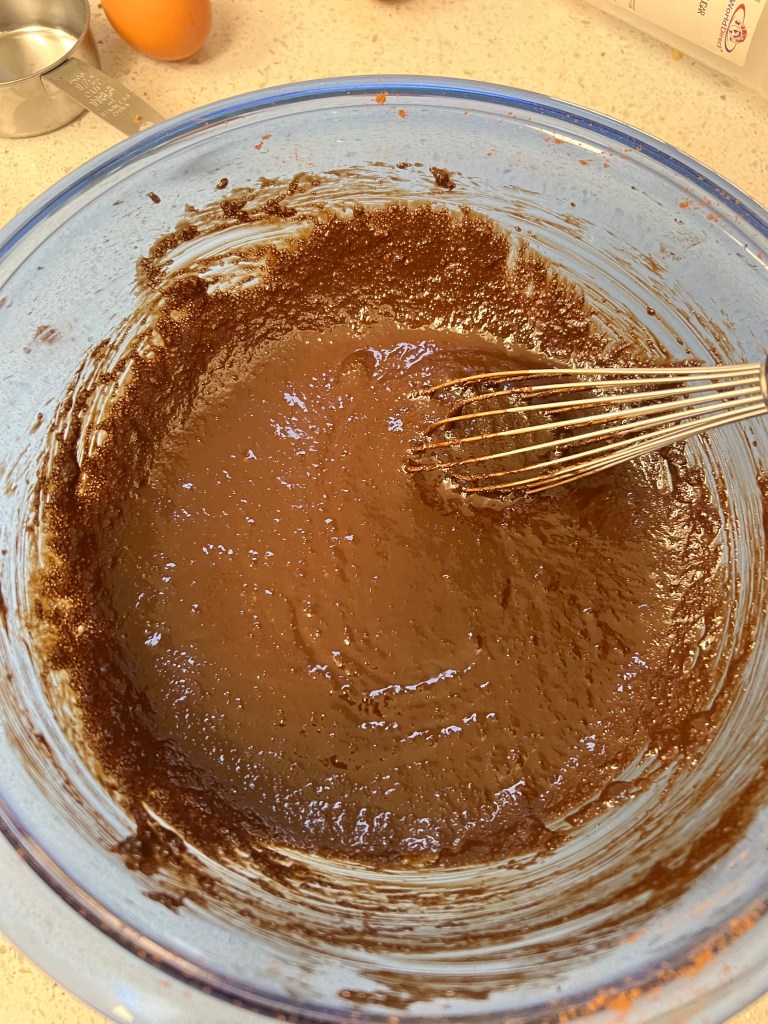
Add 3/4 cup and 2 tbsp of good dark cocoa (all kinds work but the more expensive ones will lead to a better brownie) and 1 1/4 cup of sugar and 1/2 tsp each of vanilla and salt. Mix well with a whisk. The original recipe calls for melting the butter in a double boiler and cooling the mixture but in my recipe we are now ready for the eggs. Add 2 large eggs and whisk them in – the grainy mixture should be nice and smooth now

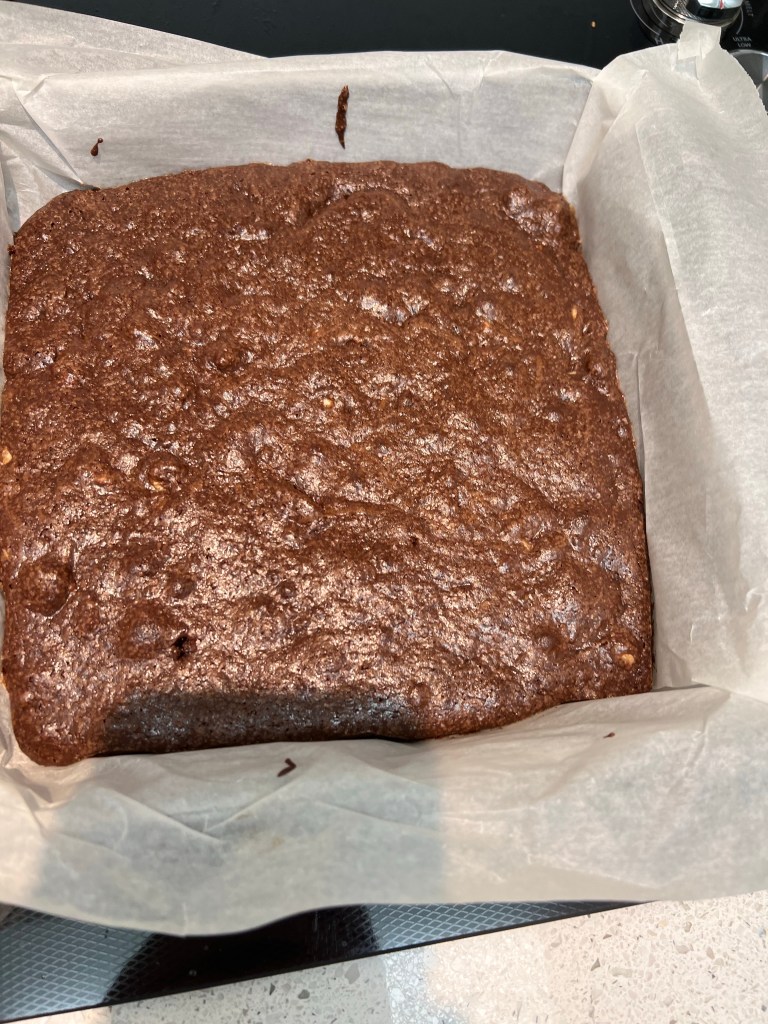
Next add 1/2 cup of whole wheat pastry flour (the original calls for 1/2 cup of all purpose flour) and beat it in with a silicone spatula till no white remains. Alice recommends doing this 40 times. Add the walnuts and stir to mix. You’d remembered to prep an 8 inch pan right? Pour mixture into said pan.

Bake for 30 min and make sure the top has set. The whole wheat flour adds an extra 5 min to the bake. Bake an additional 5 min if you’d like your brownie firmer. We like ours fudgy.

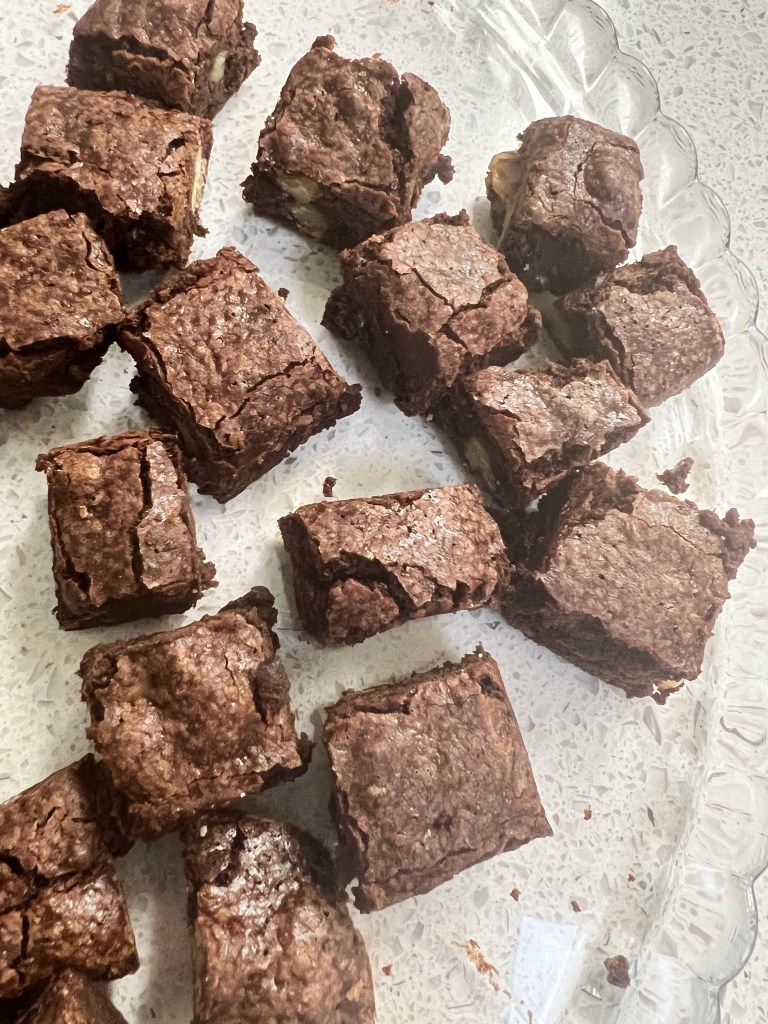
Cut into tiny bites or larger pieces. These spread happiness wherever they go.

Pistachio shortbread

I like my Diwali sweets to be easy and fuss free. This cookie doesn’t have egg, it is festive and delicious. It’s based off this NYT recipe https://cooking.nytimes.com/recipes/1019807-salted-pistachio-shortbread

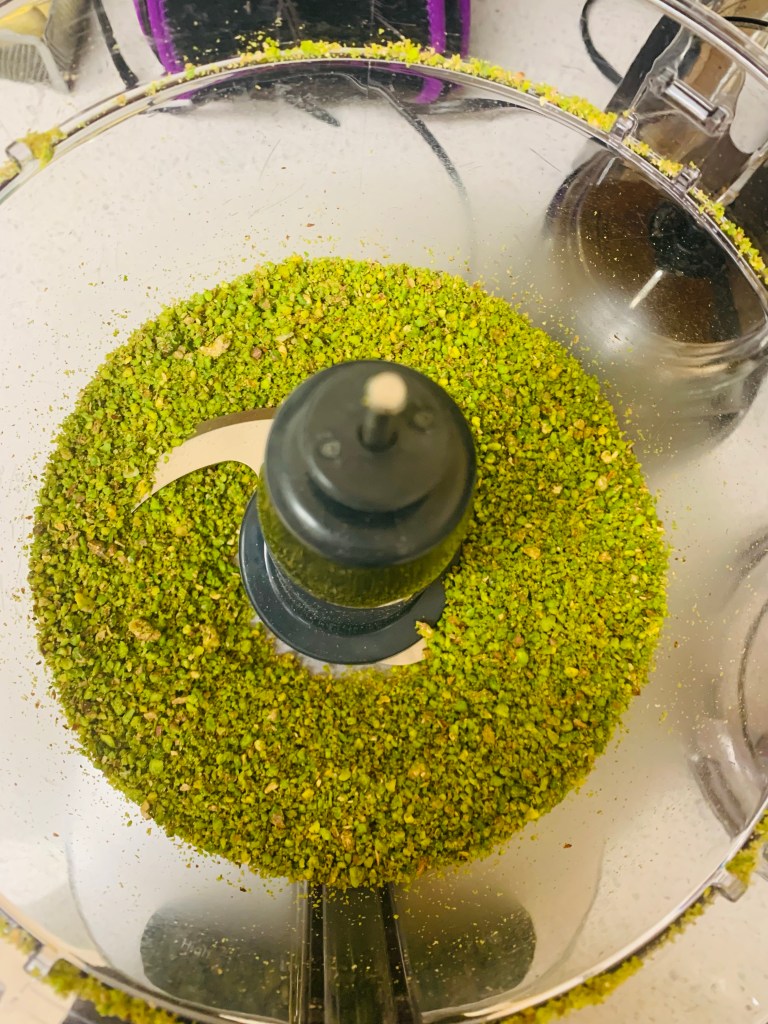
In a food processor – grind 3/4 cup shelled unsalted pistachios till fine

Add 1 stick of butter chopped and 1/3 cup of powdered sugar and pulse till combined. Add 3/4 cup all purpose flour and 1/4 tsp of salt (if you used unsalted butter). Pulse till a dough forms

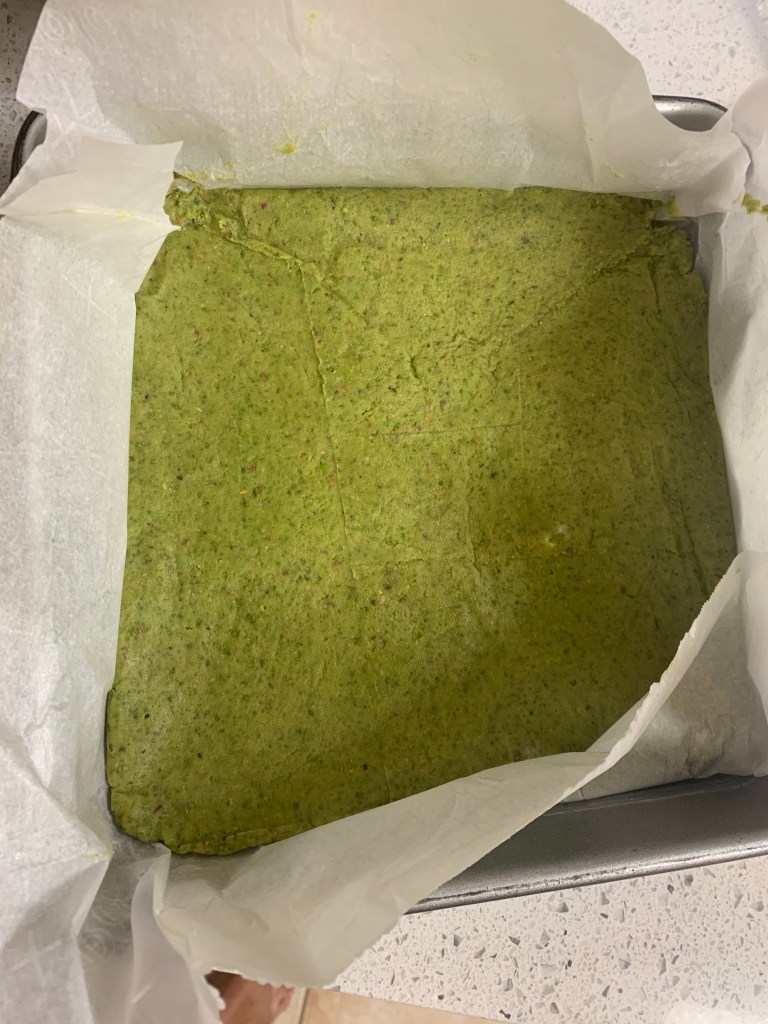
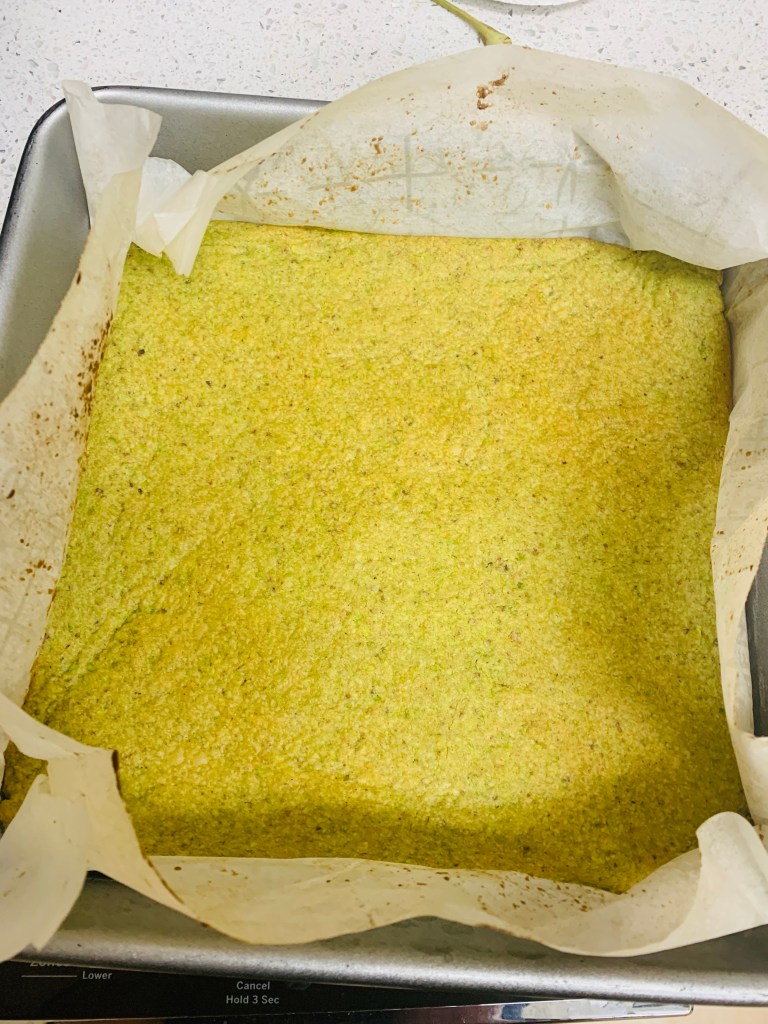
Spread into a 9×9 inch square tin lined by parchment. I use another parchment on top to get an even layer. Refrigerate for 30 min

Bake at 350 for 15-20 min till pale gold at edges

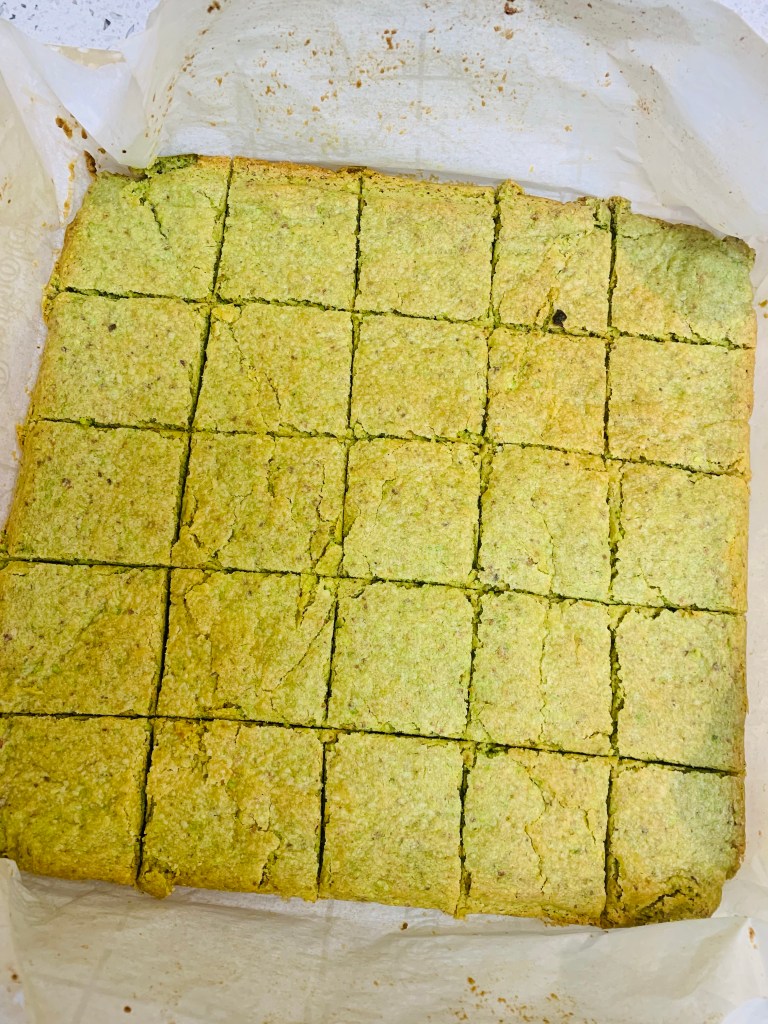
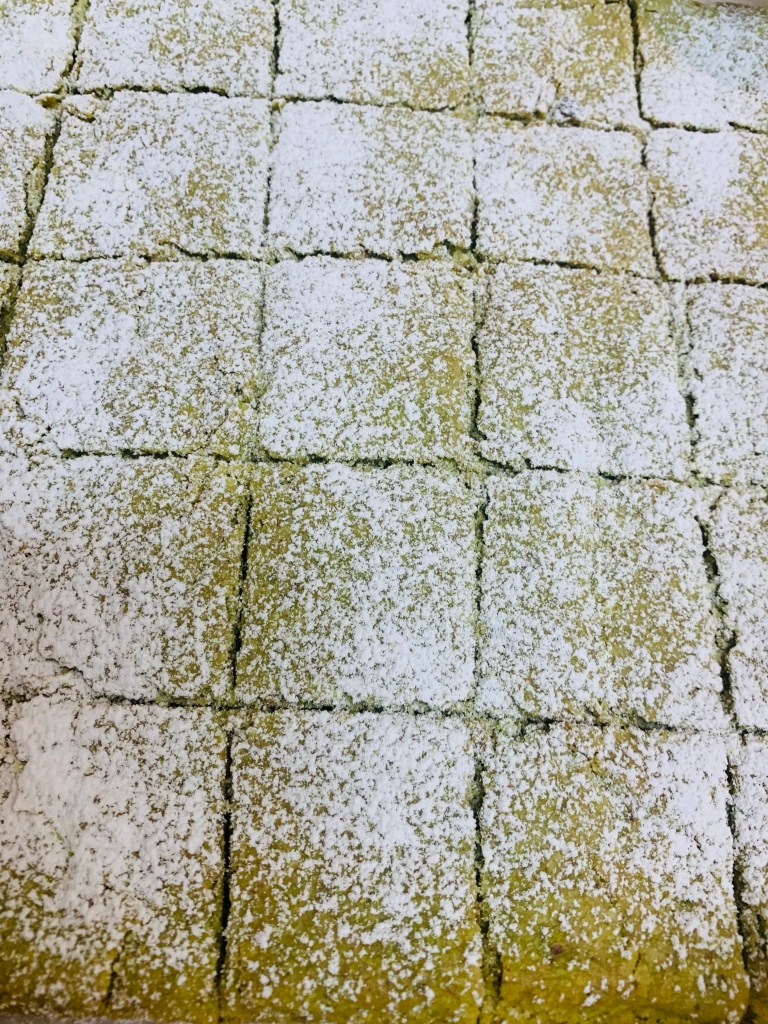
Remove using parchment as sling- the cookie will be very soft. I cut these into squares. Dust with more powdered sugar and wait for half an hour for the cookies to firm up.
The sweetness of the pistachio with the butter, the snap of a good shortbread with its melt in the mouth characteristic – this might be my new favorite cookie

Orange Almond Cake

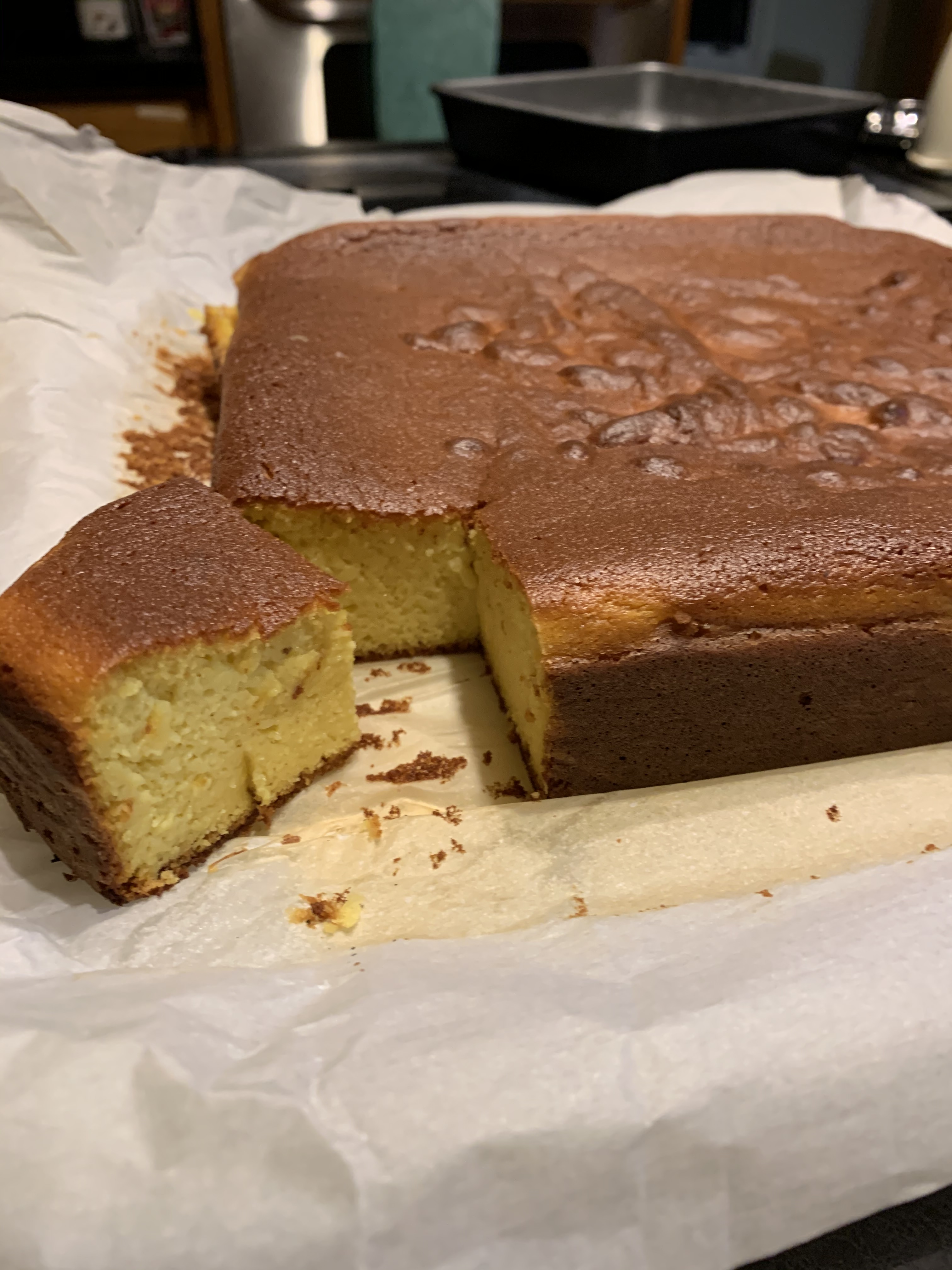
I’m naturally attracted to any recipe that starts with boiling 2 oranges for 2 hours and then blitzting them skin, pith and all. My catnip is everyday ingredients used in unusual ways. This Claudia Rogen cake is a famous cake- it routinely makes the lists of world’s best cakes and I think that is partly due to the ingredients and partly due to the texture of the final cake. This cake has a very delicate but dense sponge- the almond flour becomes drier and more “orangey” the next day. I generally serve it with whipped cream mixed with a tbsp of orange zest.

Start by boiling 2 clean oranges for 2 hours or as I did pressure cook the 2 oranges for 40 minutes. The pectin becomes all gelatinous then- think marmalade. Cool oranges- cut down the center- remove seeds and blitz to a fine puree.

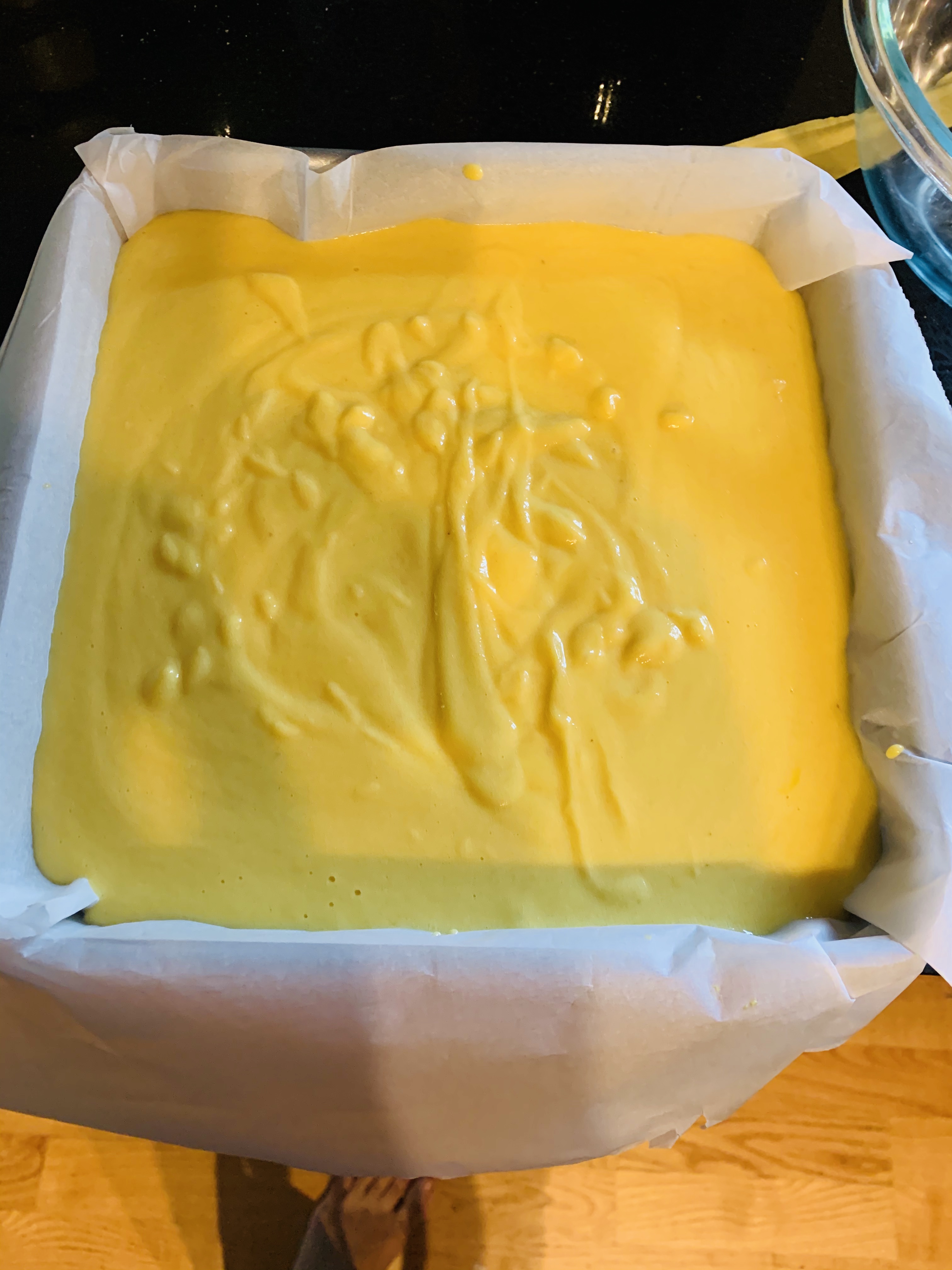
Next- heat oven to 375F. Prep a 9 inch pan- the recipe suggests a round pan with a springiform bottom, I used a 9×9 inch square pan and lots of parchment. This is a delicate cake- prepping the pan is essential. In a large bowl- whisk 6 large eggs with 250g sugar till the sugar is all dissolved (I used my stand mixer and it took about 4 minutes on medium). Add 250 g of almond flour and 1 tsp of baking powder. Mix well till mixture is homogenous. Add orange puree and pour the mixture (it will be fairly liquid) into the prepared pan. Bake at 375F for 45 minutes and start testing till a skewer comes out clean. It took 55 minutes in my oven. Let cool in pan for 10 minutes and then remove and cool on rack.

Serve with berries, cream, candied oranges – think of it as a pudding rather than a cake. It makes for an unusual end to a dinner party and it is delicious.

Pineapple Upside Down Cake by Alton Brown

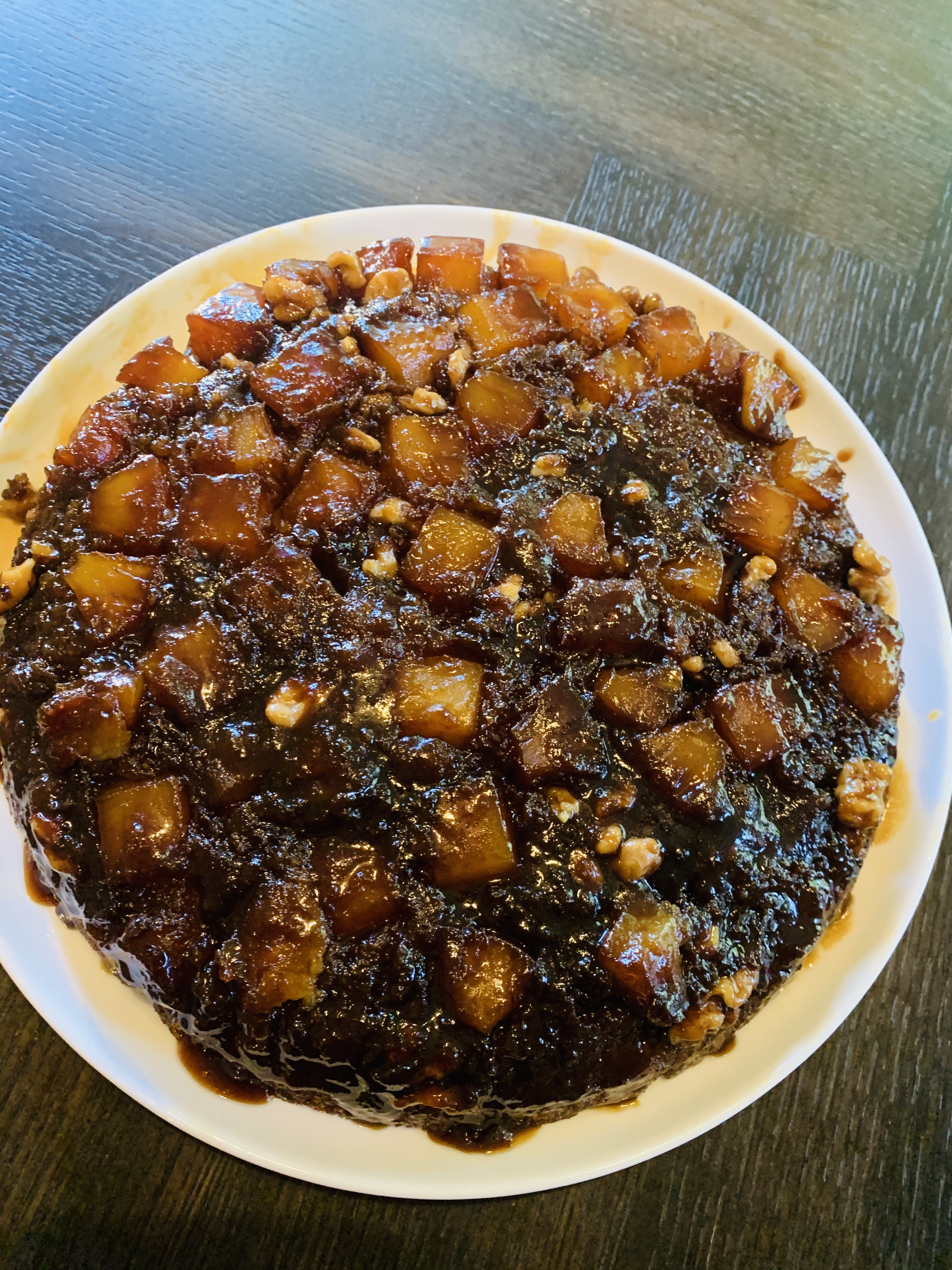
This is my favorite cake (and husband’s favorite cake) from my favorite baking book – Alton Brown’s I’m just here for more food. I’ve made it for countless dinners and potlucks over the last 15 years- it is always a hit. Two things to remember- a cast iron pan is essential as is the pineappe in heavy syrup. Fresh pineapple and pineapple in juice will work in a pinch but the cake won’t be glorious. Cast iron pans are cheap and last for ever and are totally worth it. For the perfect toffee bottom and the delicious sponge on top- you need the cast iron pan and the pineapple in syrup
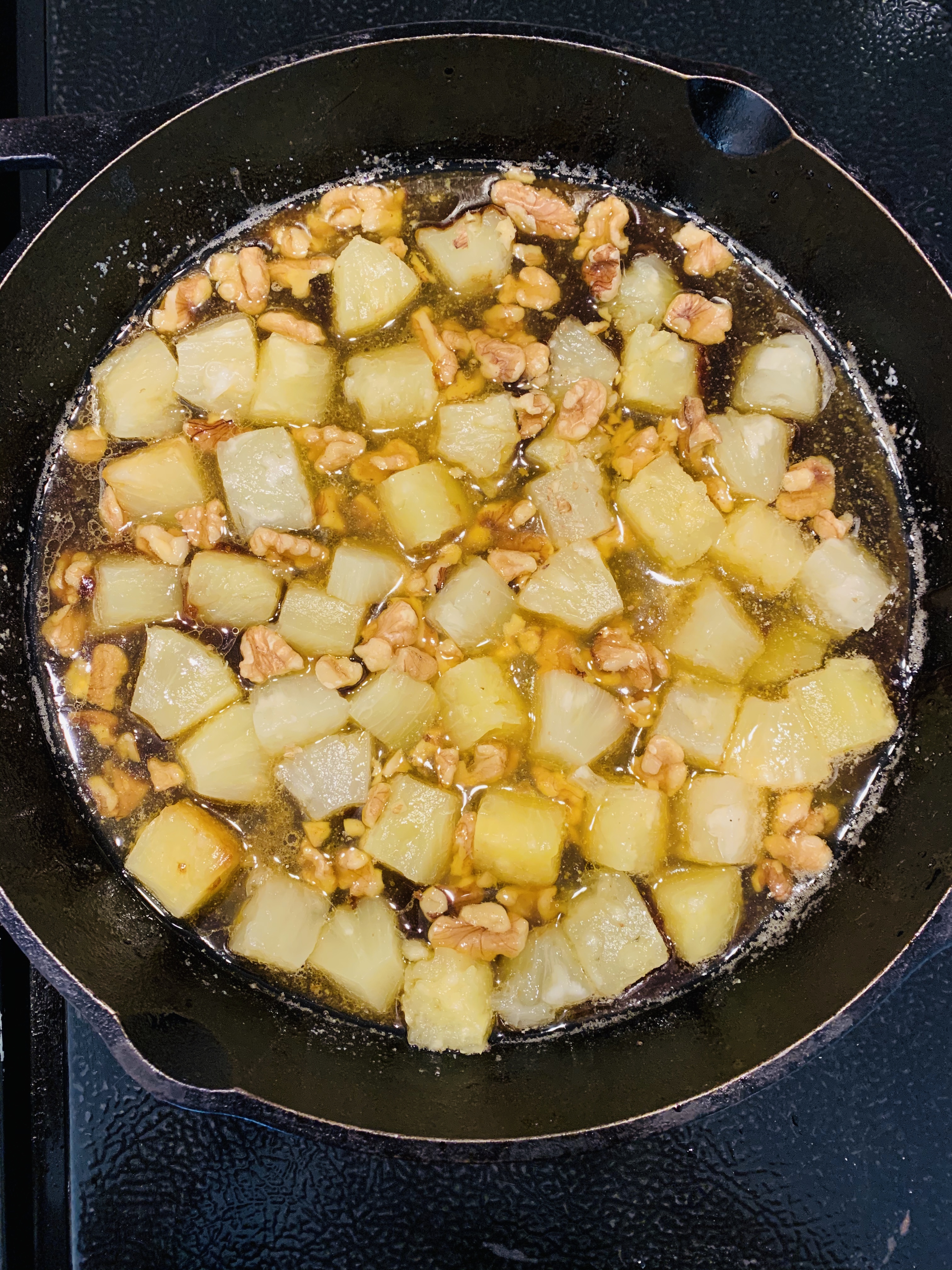
Preheat oven to 350F. Melt 1 stick of butter (8 tbsp) in a 10 inch cast iron pan and 1 cup of dark brown sugar together. It melts in about 5 minutes. Don’t burn this. Then scatter the pineapple pieces from 1 can of pineapple chunks in heavy syrup on top. Scatter 1/4 cups of chopped walnuts on top too along with 3 tbsp of the pineapple juice from the can. If you like- add a few maraschino cherries here and there. I skip those. This is the “top” of your upside down cake. Try to get the pineapple and the nuts in one layer so they will all get candied.

Wet ingredients: Whisk 3 eggs, 5 tbsp of pineapple juice and 1 cup of white granulated sugar till the sugar dissoves. Dry ingregients: Mix 1 cup of all purpose flour, 1 tsp of baking powder and 1/4 tsp salt

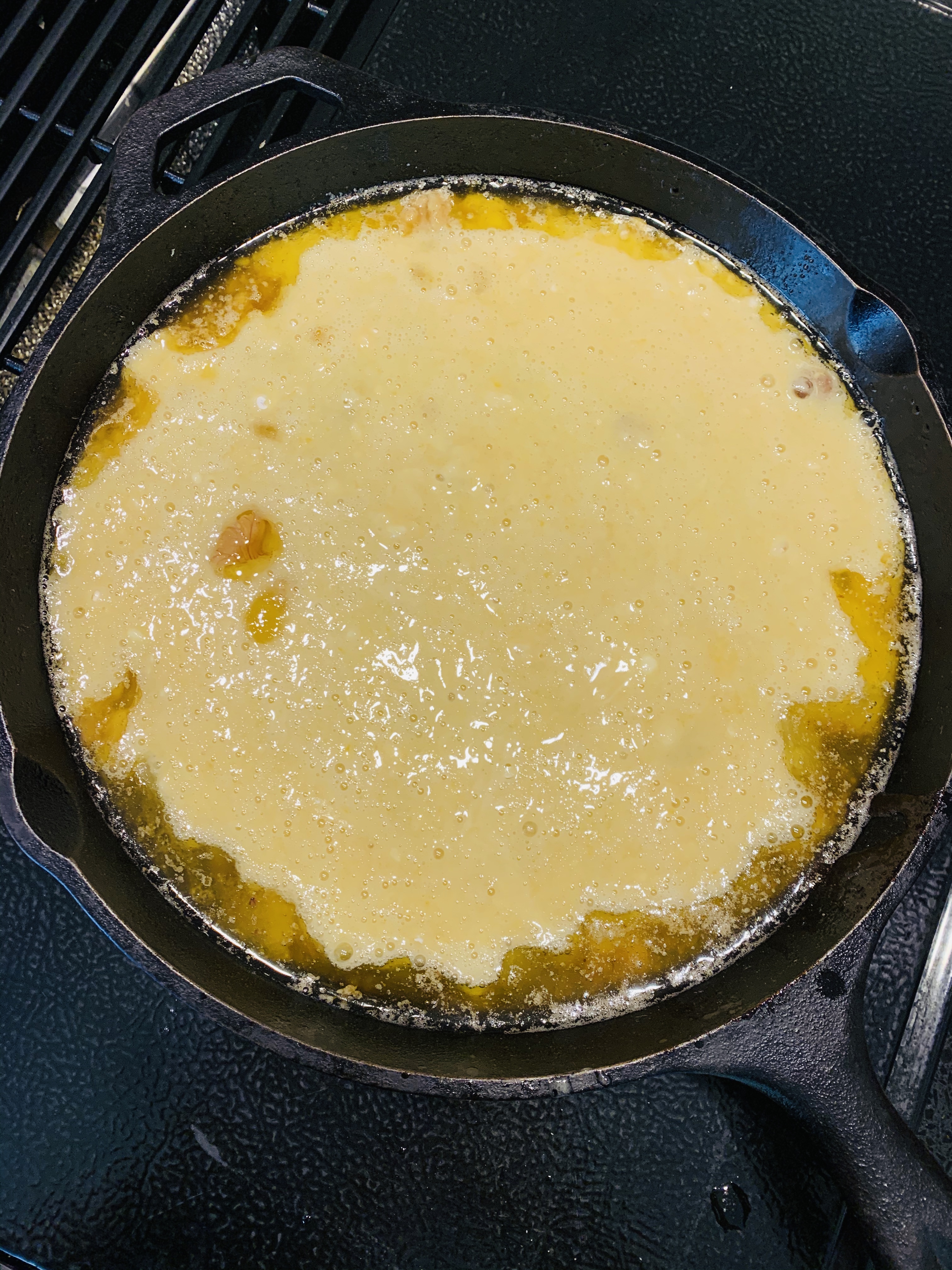
Mix the wet and dry together till they just come together- an occasional lump is fine. Dump batter into the cast iron pan. The butter will float to the top. Bake at 350F for 40 minutes. A toothpick should come out clean and the internal temp should be 210F.

I’m all for instant gratification but this cake needs about 10 minutes for the hot sugar and butter to cool down. Invert on a cake platter and eat vast quantities of it with joy.

American Sandwich Bread from Bread Illustrated

I’ve spoken before of my love for Bread Illustrated, one of my favorite bread books. Others bake sourdough- I don’t, I worry about mold and other bacteria in the “mother”. So I stick to dried yeasts. This is a good intermediate bread to start with. It is also delicious- the honey makes it very slightly sweet. I’ve always used a stand mixer for this- I guess you could do it by hand and use the same gluten development tests I talk about. You need a 81/2 by 41/2 inch loaf pan and high gluten bread flour for this recipe. An instant read thermometer is ideal.

Weigh out/measure the wet and dry ingredients. The wet ingredients measure well by volume, the flour not so much- weighing it is best.

Dry ingredients: In the bowl of a stand mixer- weigh out 13.75 oz of bread flour (2 and half cups) with 2 tsp instant yeast and 1.5 tsp kosher salt

Wet ingredients: Mix 6oz whole milk (3/4 cup) and 2.66 oz water (1/3 cup) and 2 tsp of melted unsalted butter and 2 tbsp of honey. Get this to room temperature and dissolve the honey well

Mix: Add wet ingredients to dry and mix with a dough hook. Start slow and go to medium speed. It takes about 8 minutes. Do the window test- see if you can spread a golf ball sized dough piece enough to allow light to shine through it- if the dough tears- you need more gluten development and knead for 2 more minutes. The dough should be smooth and clear the sides of the bowl- if it sticks to the bottom of the mixer- that is ok.

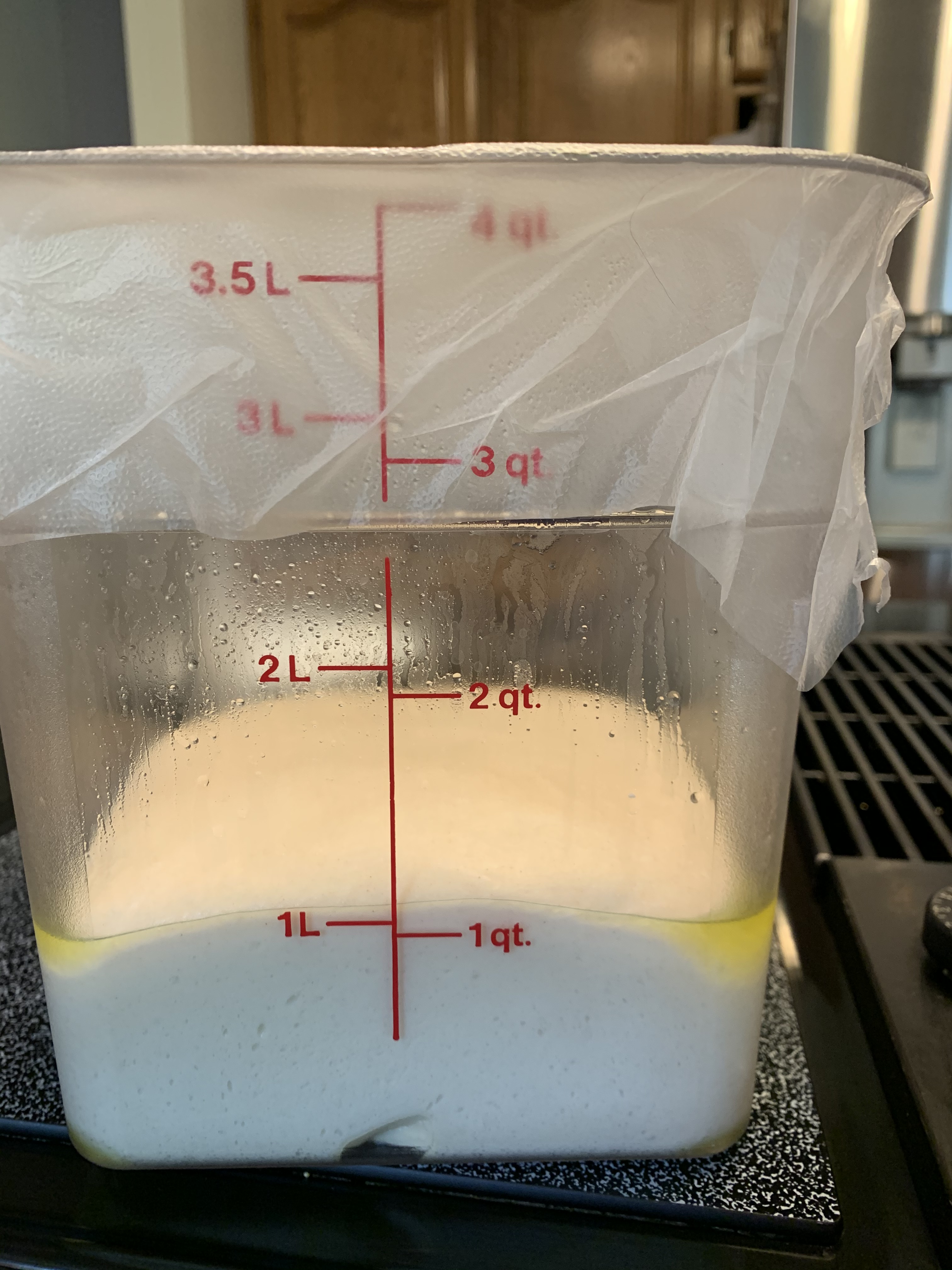
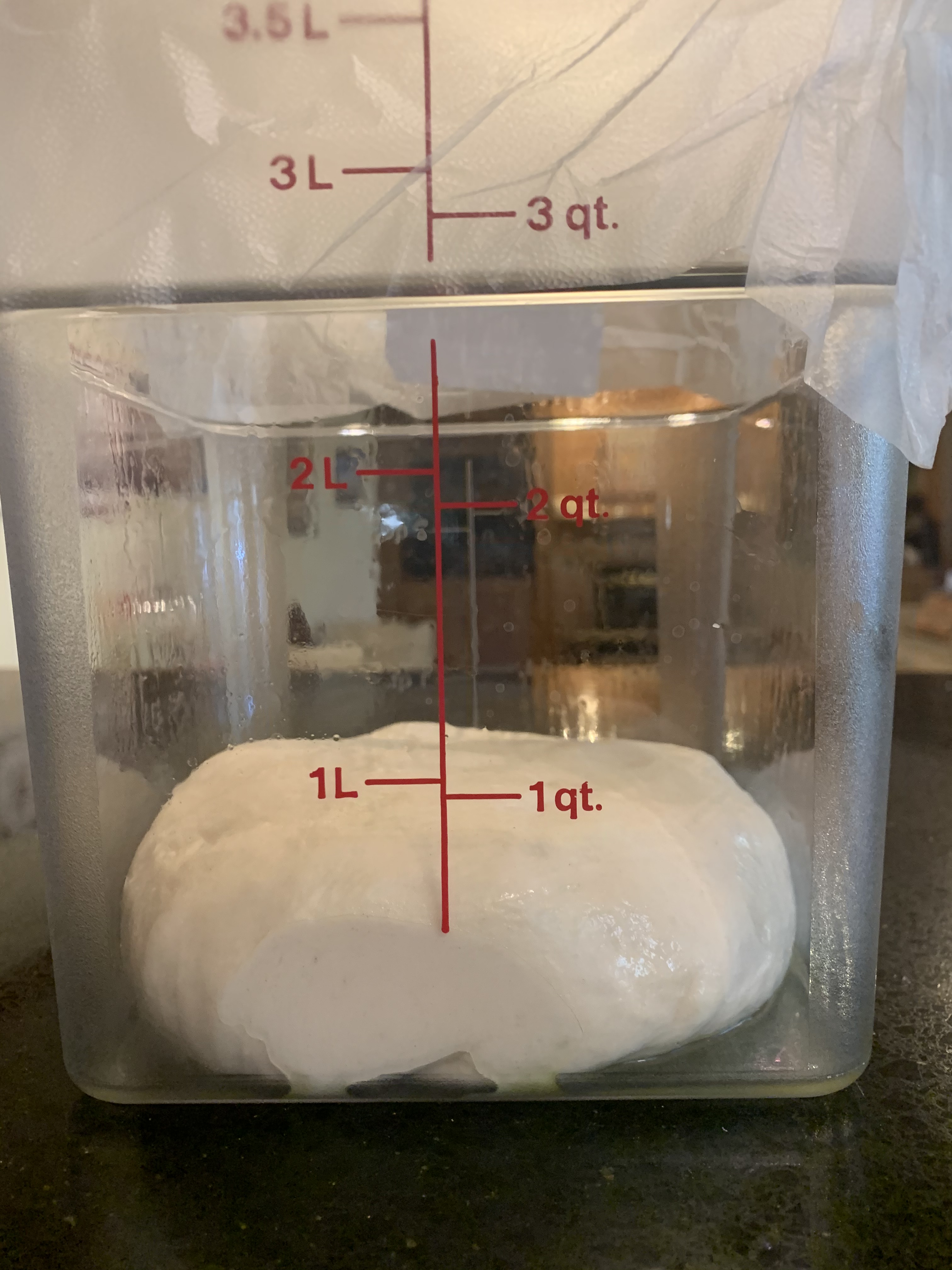
Proof 1: Take dough out of mixer and knead gently into a round smooth ball. Proof in a oiled covered container. A square container with volume markings helps you measure the “doubling in size”. This takes about 2 hours at 85F and will take longer if your home is cooler (I have a proofing setting in my oven)

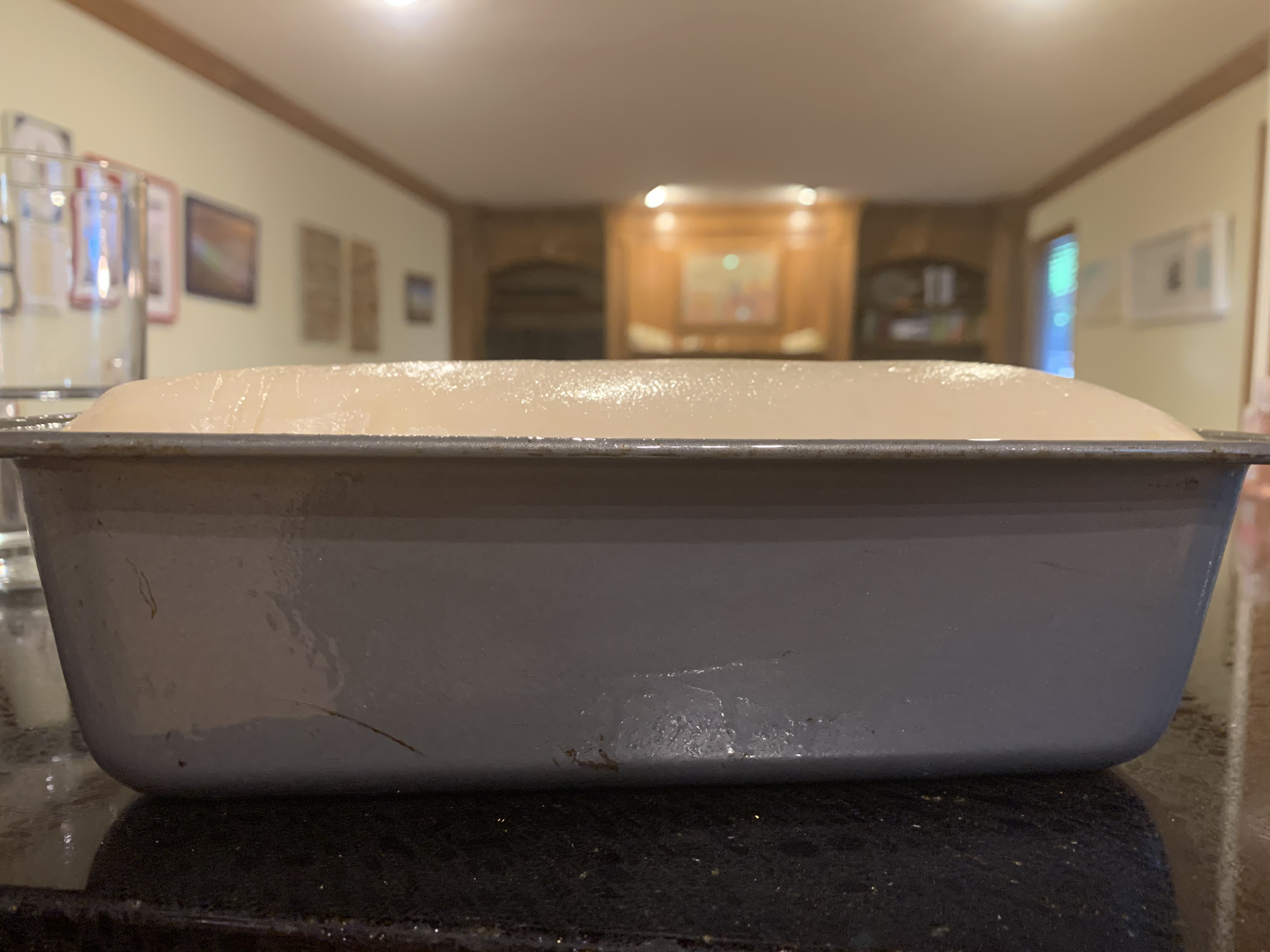
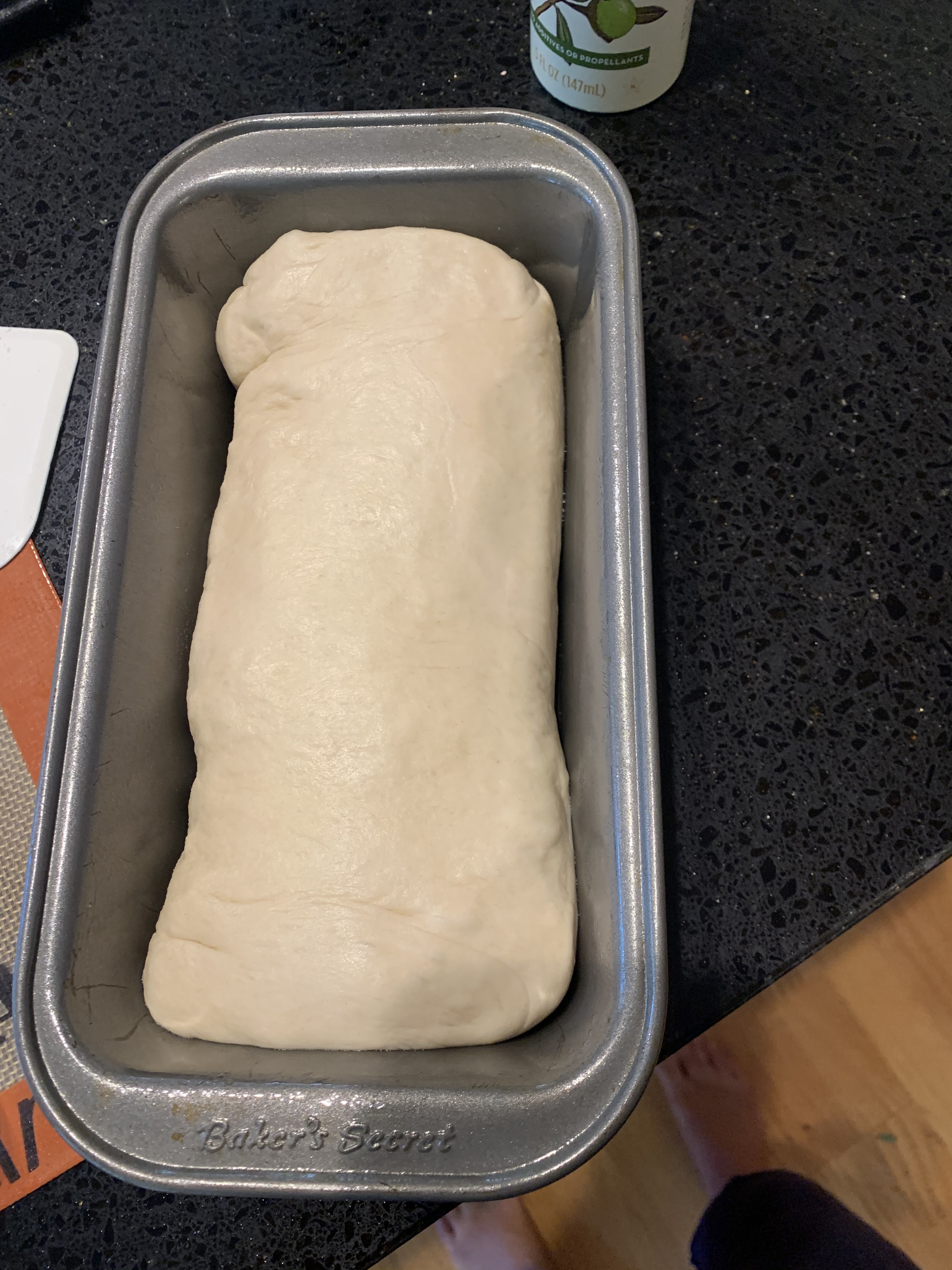
Proof 2: Grease your loaf pan. Remove dough on lightly floured surface and flatten gently into an 8 inch by 6 inch rectangle. Roll tighly to form an 8 inch cylinder. Pinch the seams and drop into your loaf pan for the second proof. Cover with oiled plastic film till the bread rises a inch above the lip of the loaf pan and if you indent the dough with a knuckle, it barely bounces back

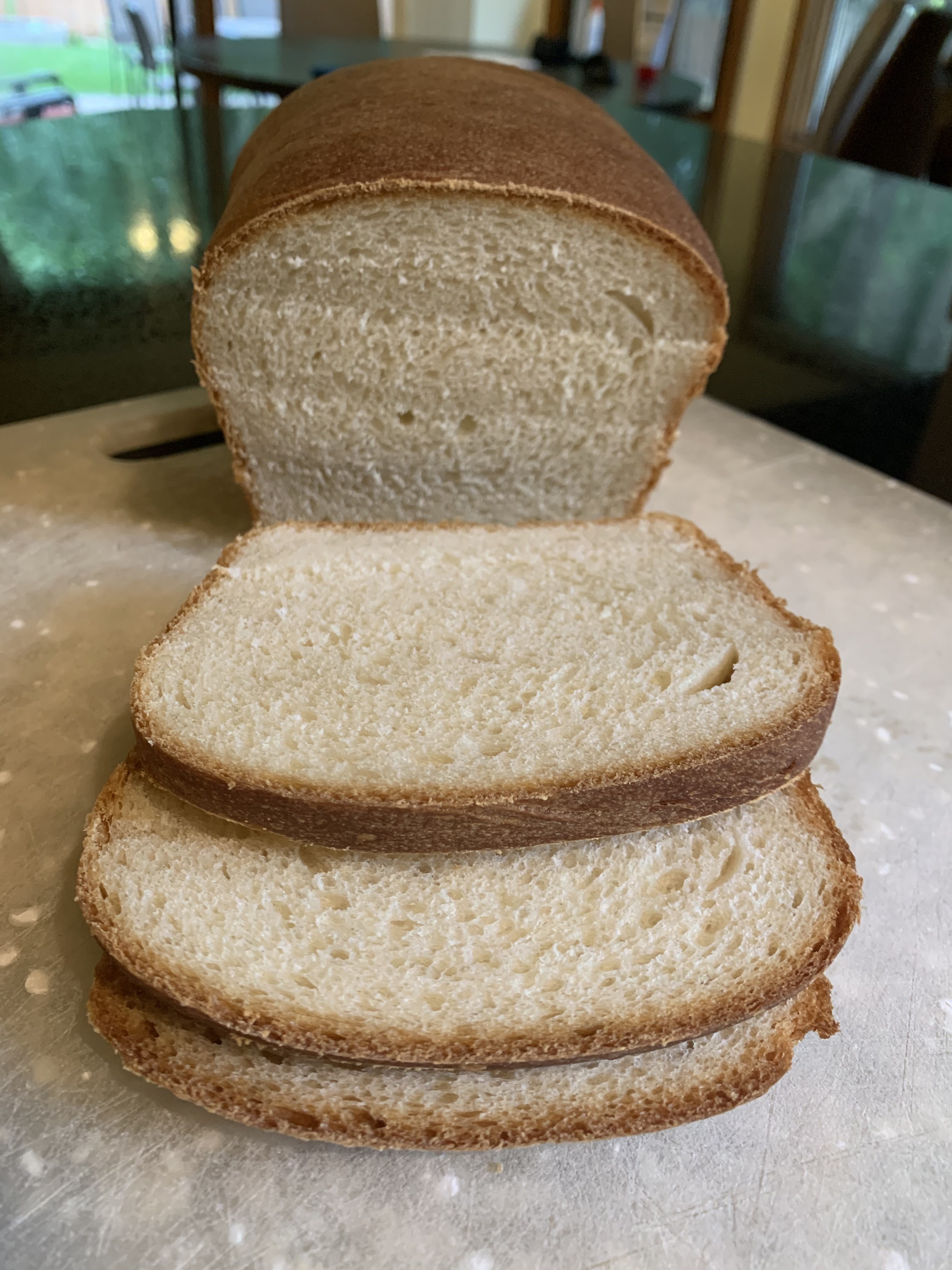
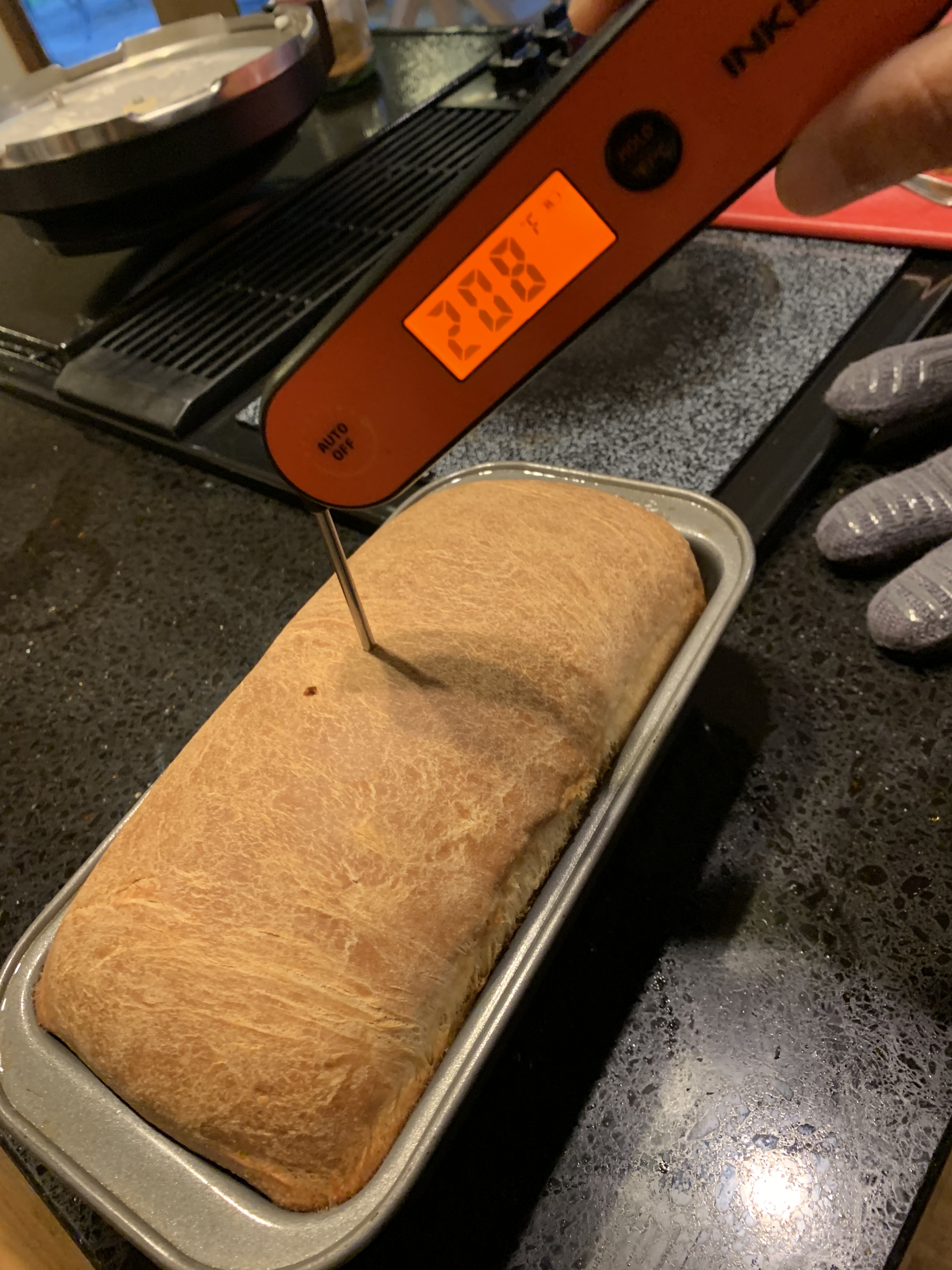
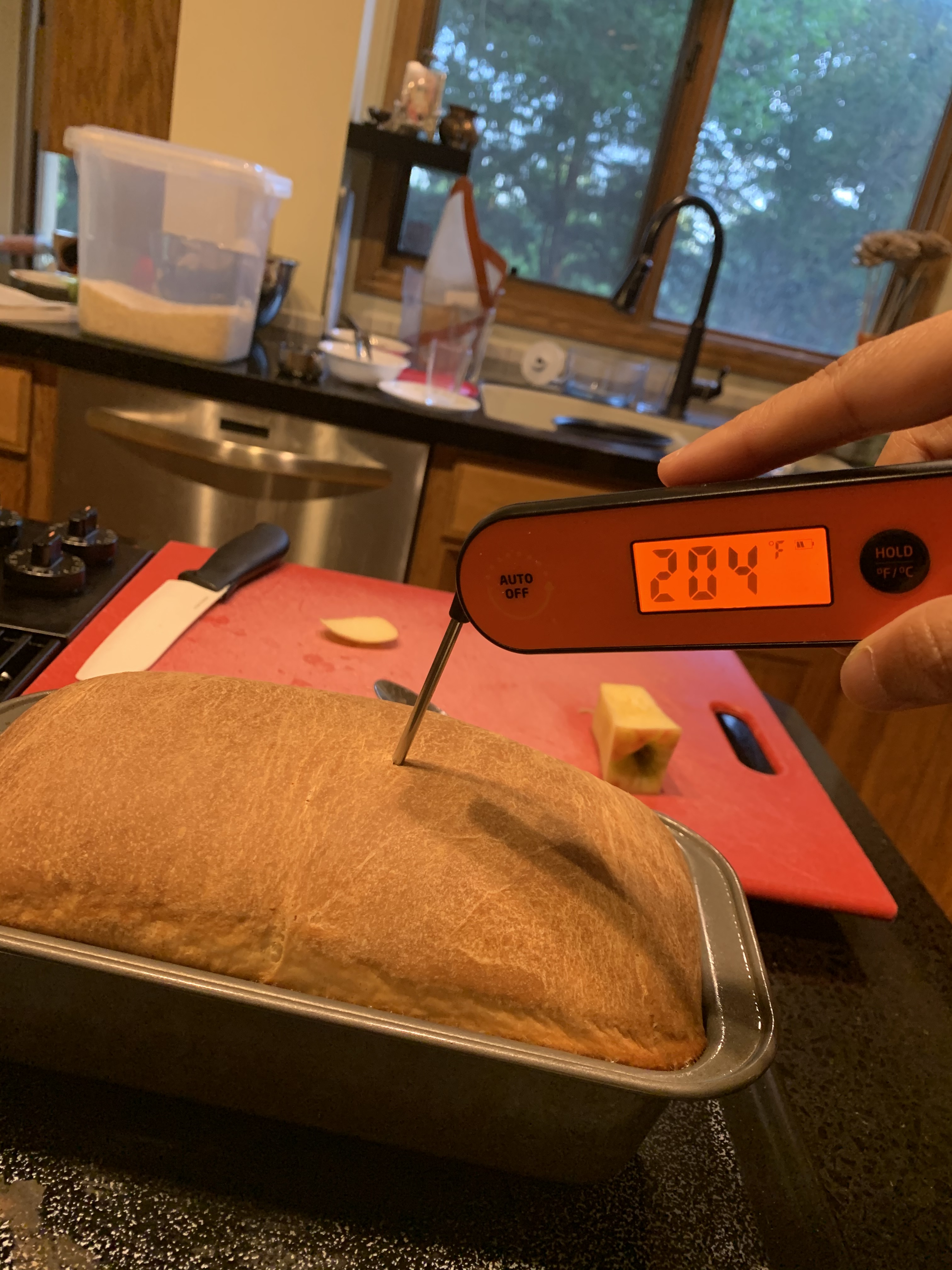
Bake: Spritz with water or brush top of loaf with water and bake in a 350 degree oven for 35-40 minutes, rotating the loaf once midway. The bread is done when the top is golden brown and the temperature of the loaf reads between 205-210F. Let loaf cool in pan for 15 minutes and then on a wire rack for 2-3 hours before slicing.

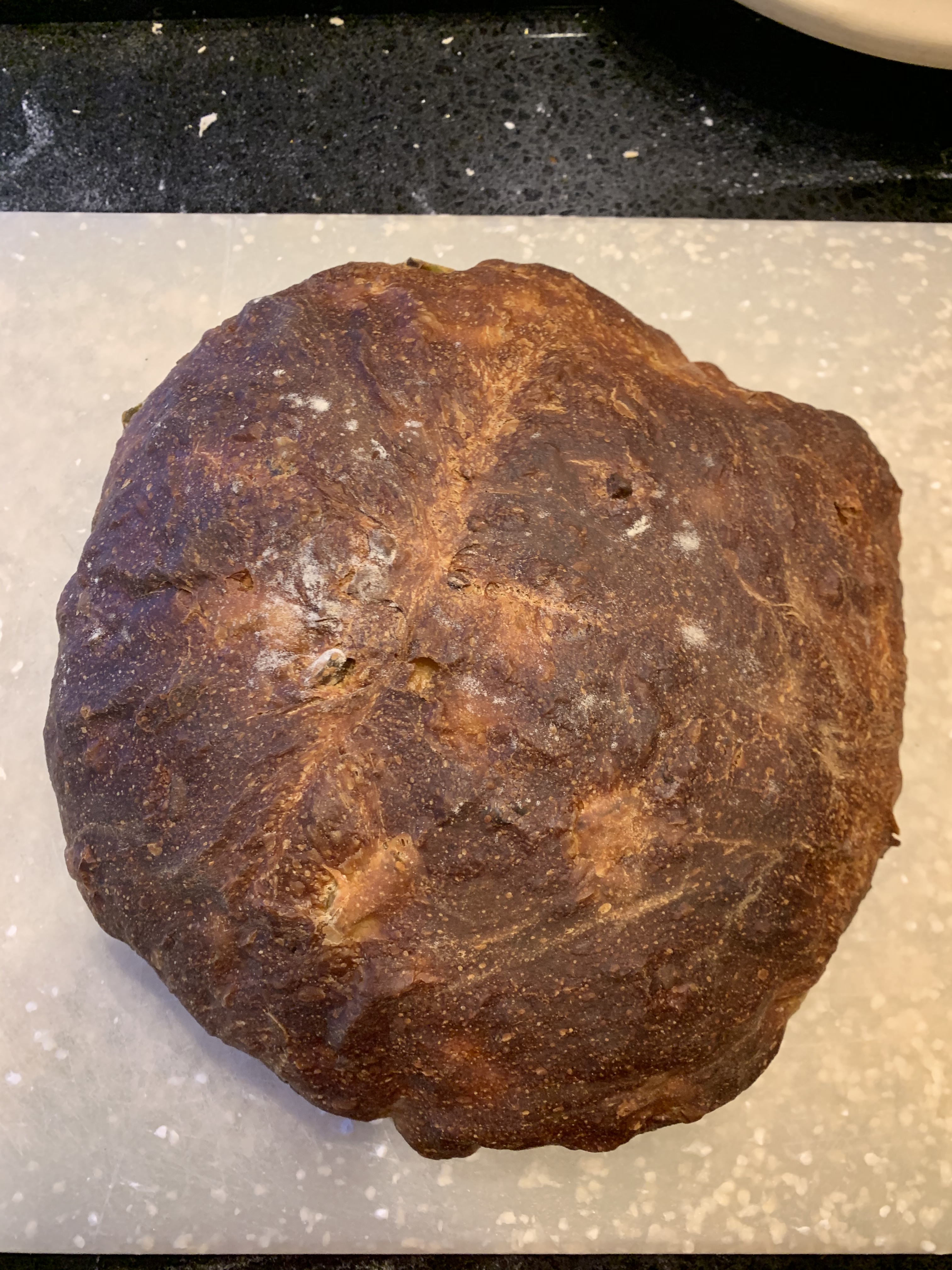
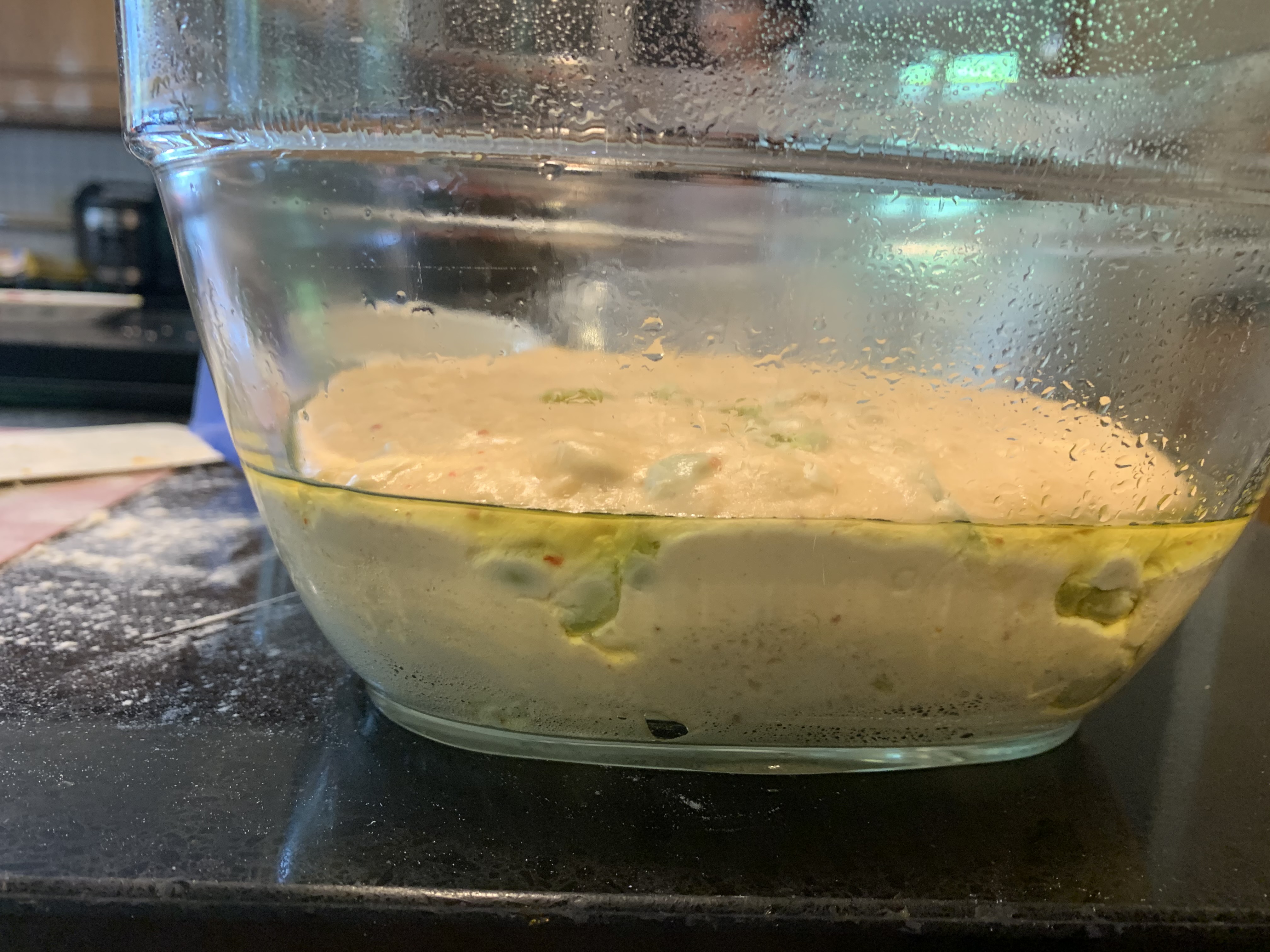
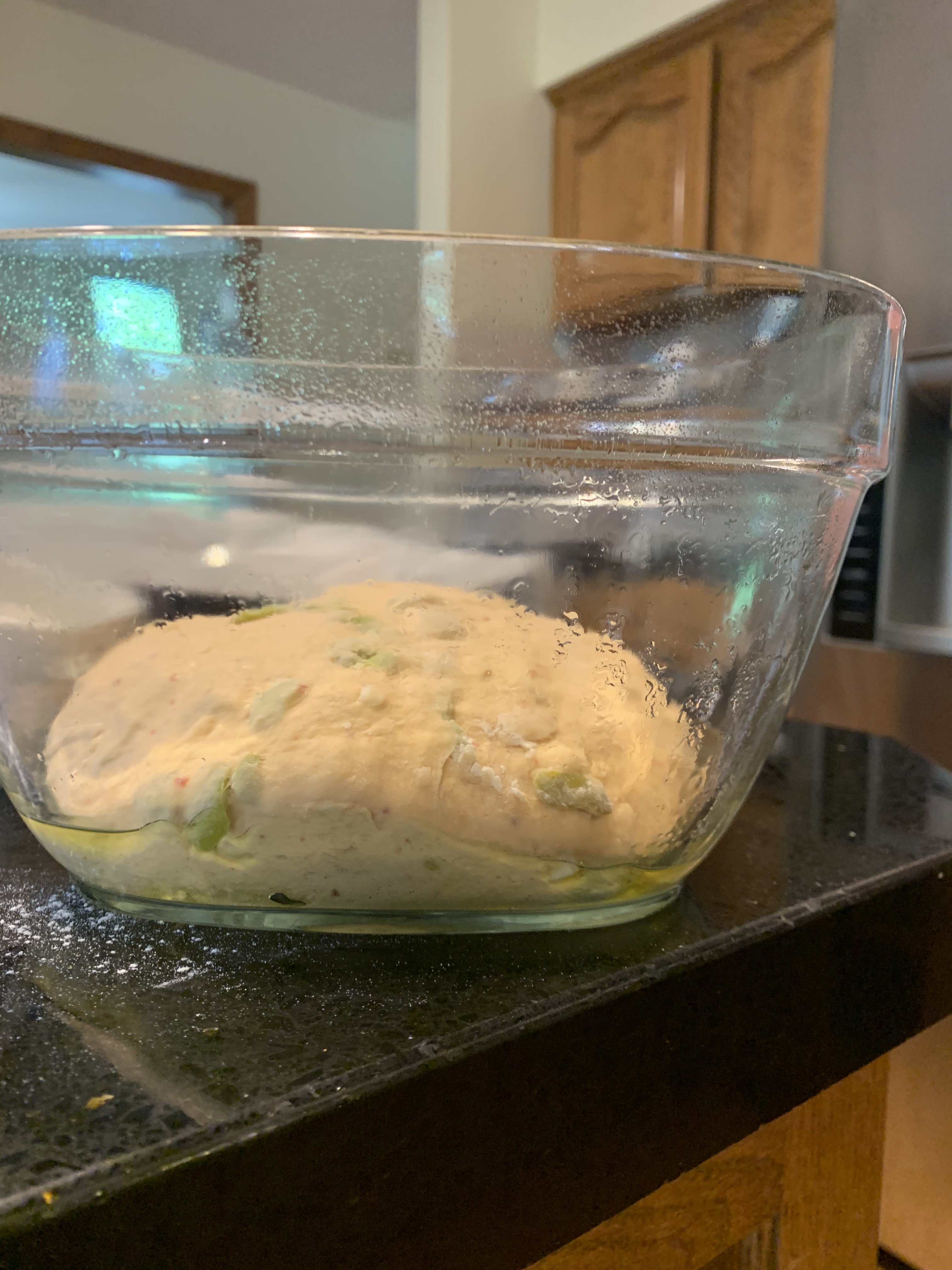
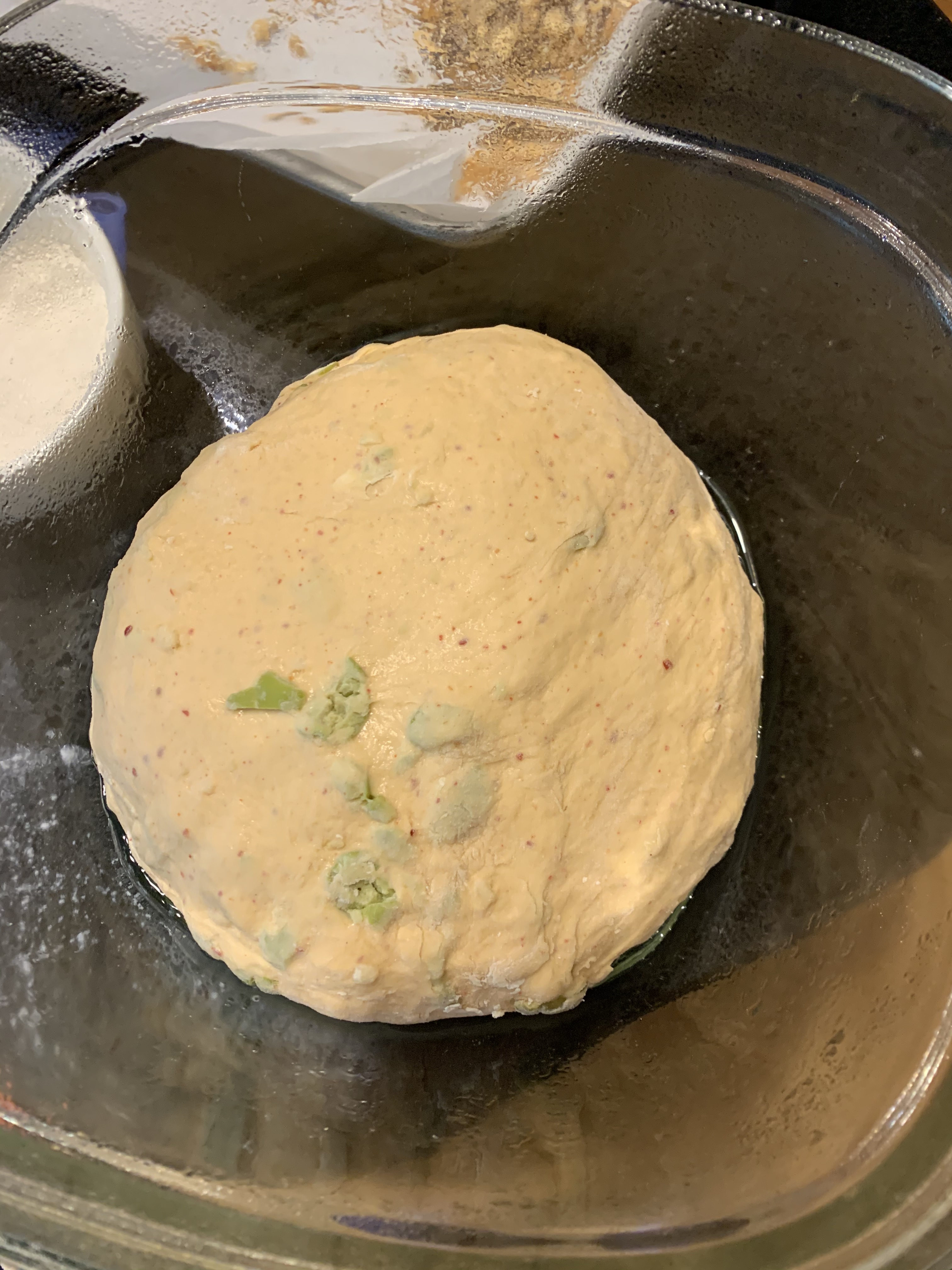
Spicy Olive Bread

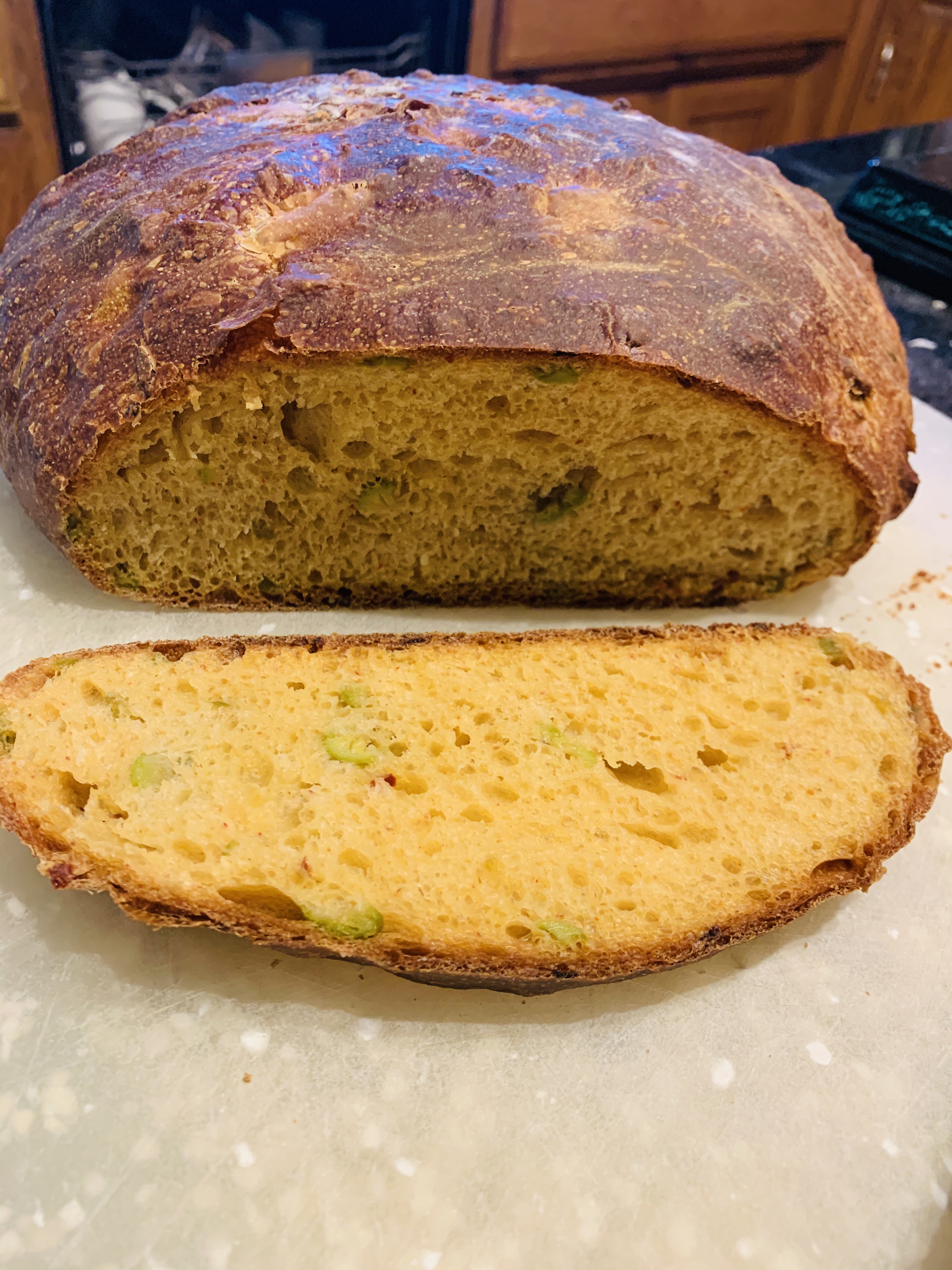
This is the spicy garlickly olive loaf from Bread Illustrated – the bread book from America’s test kitchen. This is my second favorite bread book- my heart still belongs to Artisan Bread in Five Minutes. Both books do a lovely job explaning the science of bread and are excellent for beginning – intermediate bakers. I liked this loaf- by itself with soup, toasted with eggs for brunch. But my family absolutely adored this bread- they finished this 1.5 lb loaf within 2 days. This recipe uses bread flour.

  1. Mix 3/4 cup of coarse chopped olives and 2 minced garlic cloves
  2. In a stand mixer with a dough hook- add 3 cups (16.5 oz) of bread flour, 2 tsp instant yeast, 2 tsp kosher salt, 2 tsp red pepper flakes and stir on low till mixed for about a minute. Add 2 tbsp of sugar to 1.3 cups (10.66 oz) of room temperature water and 1 tbsp olive oil. Once dissolved, add to the stand mixer. Mix on low for 2 minutes.
  3. Increase speed to medium low and knead for 8-10 minutes till the dough passes the windowpane test (rest the dough for a minute- can you stretch a golf ball piece of the dough thin enough to make a window that lets light through?). If not- knead for another 2 minutes. This dough will look a little dry- don’t add more water- the olives in the next step will make it wetter.
  4. Add the olive-garlic mixture 1-2 tbsp at a time while mixing on low. Take dough out on lightly floured counter- knead for a minute or so- make a round ball and place in an oiled container seam down.
  5. Proof for 1.5 or 2 hours till doubled in size
  6. Remove dough to a floured counter- flatten gently to a 10 inch circle. Shape the dough by folding the edges to the center. Flip the dough ball- seam side down and drag it in small circles on the counter till it is a taut ball covered with a thin layer of flour. This is important for the shape of the final bread. Lay the dough ball on parchment paper covered with a mixing bowl for the second rise for 30 min-1 hour till the poke test is positive (when you poke the dough- the dough should spring back minimally).
  7. Heat oven to 450 F and preheat a large dutch oven or a ceramic bakers cloche (this bread- like most nonenriched breads- needs steam at the start for the crust to develop)
  8. Carefully remove dutch oven or cloche from the oven and using the parchment as a sling, lower bread into the dutch oven (this is why I prefer the cloche)
  9. Bake covered for 30 minutes at 450F, then uncovered for 20-25 minutes at 375 F till interior temperature is 210 F and the bread is golden brown.
  10. Cool for 2-3 hours before eating (PS: this is an impossible instruction)

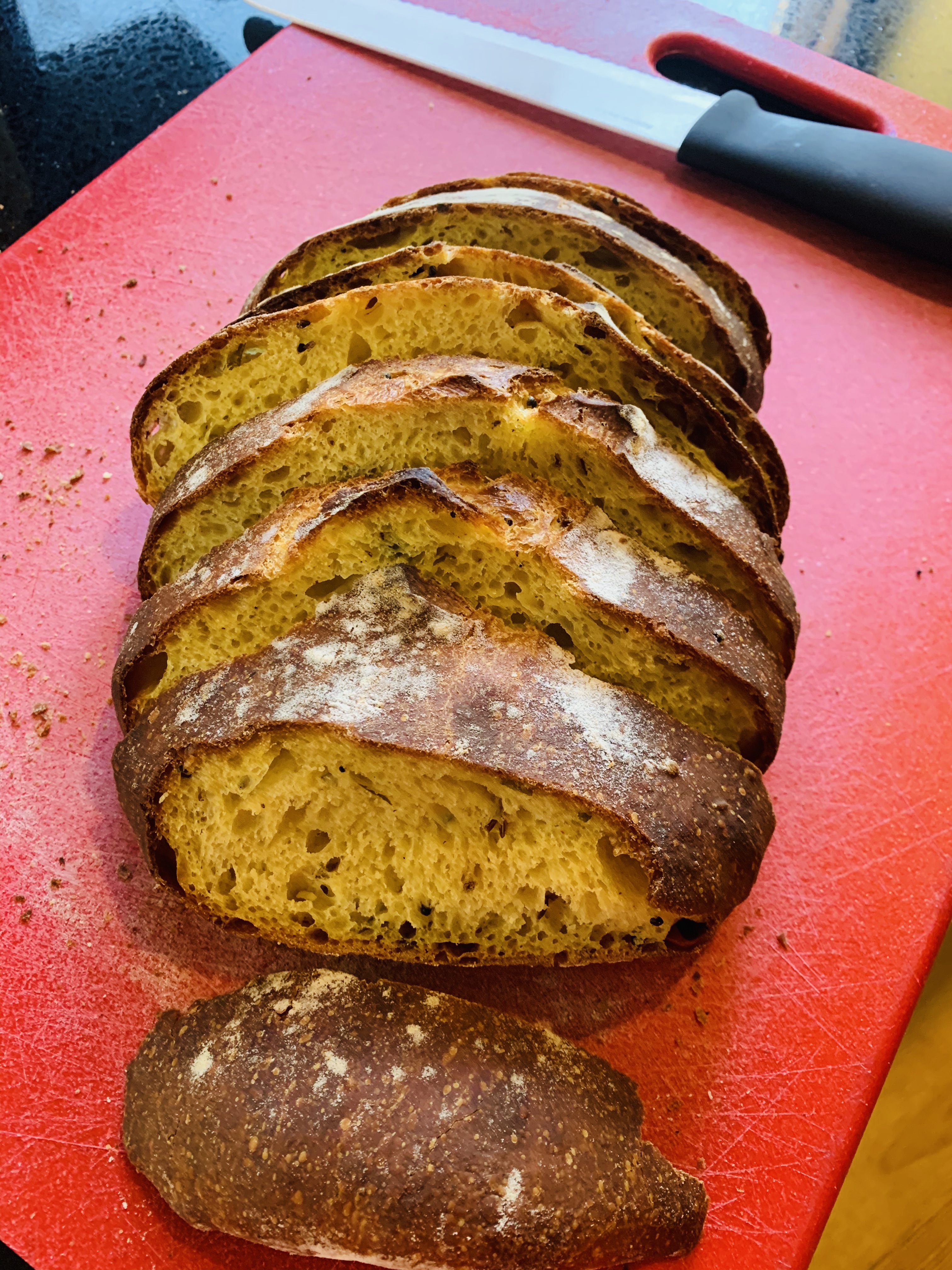
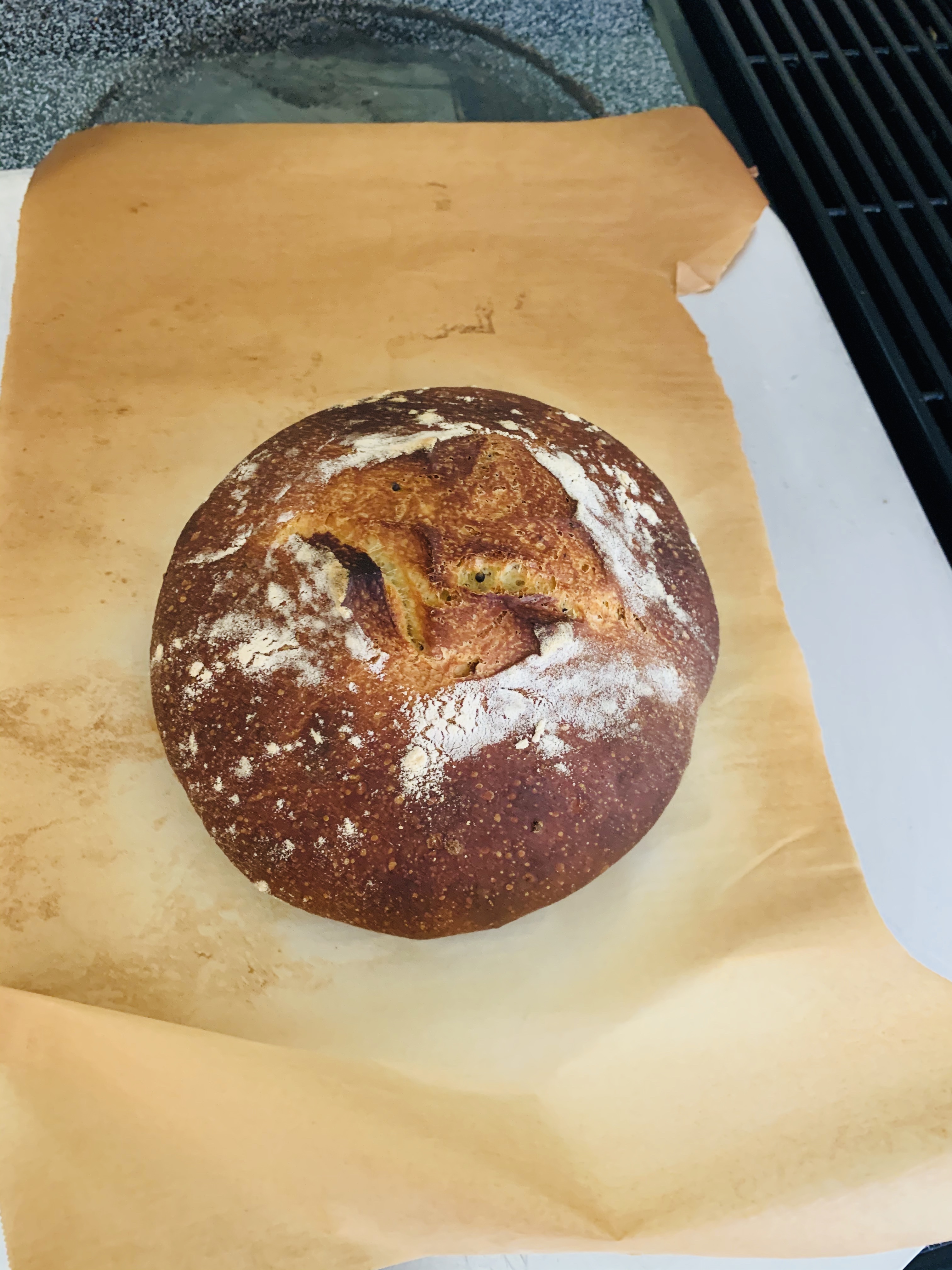
Rye Bread

The quarantine has led me to a lot of bread recipes. I enjoy trying new things but I come back again and again to my favorite loaf .The recipe works as a boule and a loaf. It is delicious with butter, hearty enough for soup and fantastic as garlic bread. This is a recipe from my all time favorite bread book- Artisan Bread in Five Minutes a Day. Everyone should buy this book . The premise is simple, make a no-knead dough and let it rise slowly. The yeast does the gluten development for you. Let it rest in your refrigerator. The bread picks up delicious sourdough flavors. When you want to bake, all you have to do is separate out enough dough for one loaf and shape and let it rise.

This recipe makes two loaves- about a pound each. This can be doubled easily if you are planning to bake 4 loaves over 14 days.

  1. Mix 1.5 cups of lukewarm water with 1/2 tbsp of instant or active dry yeast. Add to 60 gm of rye flour (1/2 cup) and 390 g of all purpose flour (around 2 3/4 cups) and 1/2 tbsp of caraway seeds and 3/4 tbsp of kosher salt. I mix with a danish whisk but you can use a spoon or your hands or the paddle on a stand mixer-  make sure all the flour is incorporated.  Do not knead
  2. Cover and let rise at room temperature for 2-3 hours (until the dough rises and then flattens on top)
  3. Refrigerate and use within the next 14 days (it really is that easy)
  4. Baking day! Seperate out half the dough and shape  into the bread you wish. Dust your worksurface with flour and shape into a ball or an oblong if you plan a loaf.This is the toughest part. The dough will be wet and sticky and it is important to shape it properly with a thin film of flour. If this is your first time- watch some youtube videos. Place on parchment or a greased loaf pan (8 1/4 inch) . Cover with a dome or greased plastic wrap and let it rise for 1-2 hours. In a loaf pan, the bread will be about half an inch below the lip of the pan.
  5. Make the cornstarch wash (mix 1/2 cup of water and 1/2 tsp of cornflour and microwave for 1-2 minutes till glossy )
  6. Preheat oven to 450 F with a baking stone for 30 minutes. This bread needs steam at the start of the baking to  soften the crust and to allow it to rise. Any steam injecting method will work. I bake in a covered dutch oven if I am baking a round, if I am baking a loaf , I add a pan with water while the oven is preheating.
  7. Paint the top of the loaf with cornstarch wash, sprinkle with caraway seeds. If you are making a round- make a slash with a knife about an inch deep. If you are baking a loaf- your top will split (I’m ok with that, if you aren’t- there are slashing techniques to prevent that).
  8. Bake for 30 minutes. Cool before slicing.

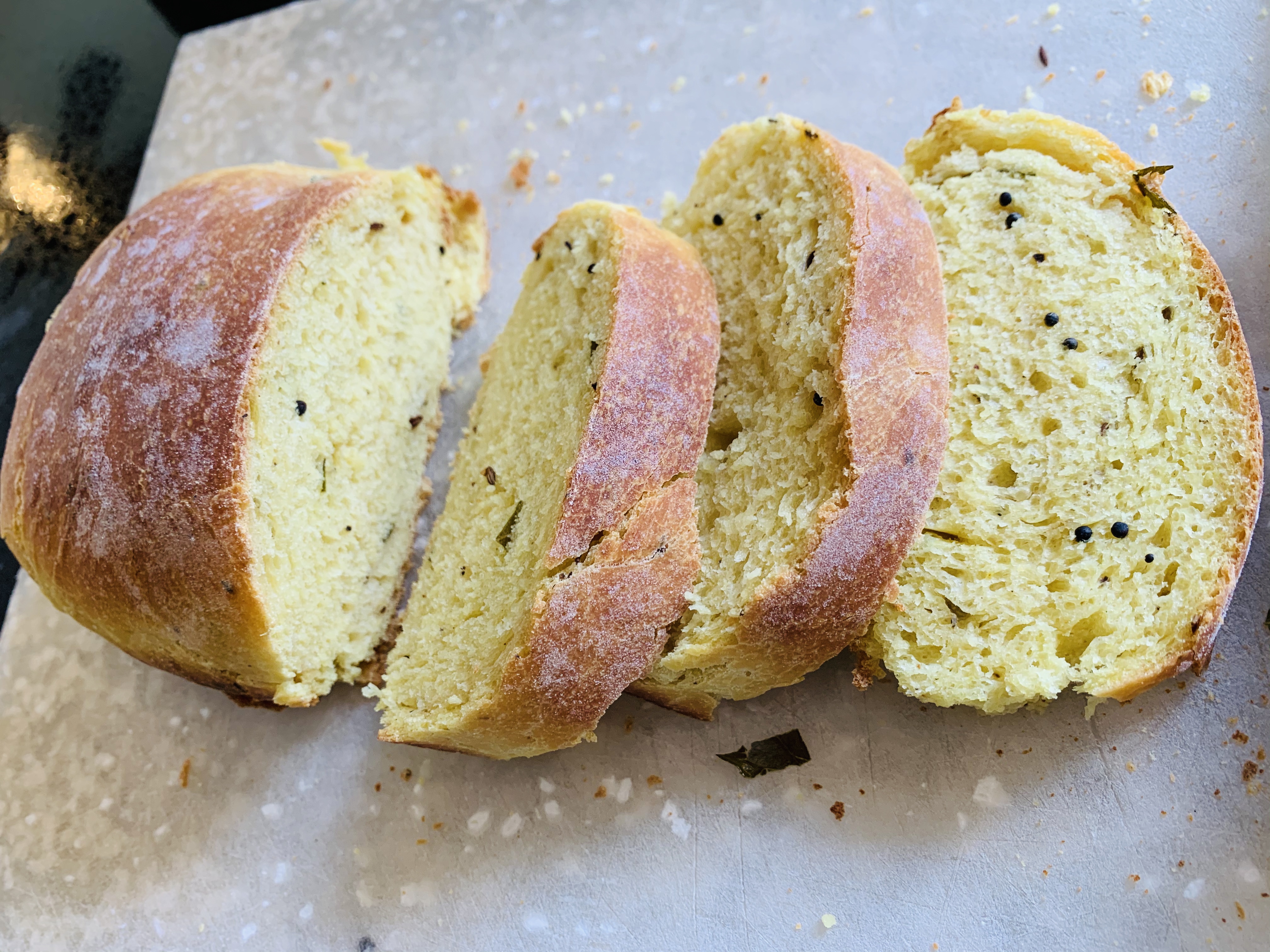
Masala Bread with curry leaves and turmeric

Flavor in Indian cooking comes from the tadka, when oil is infused with dried spices. This oil carries the flavor to the vegetables, dals, rice. This masala bread uses the same technique. The flavor really comes through and the bread is a lovely bright yellow. This is delicious with regular tomato soup and in a grilled cheese sandwich.  I’ve modified my favorite bread recipe (Olive oil dough) in my favorite baking book- the New Artisan Bread in Five Minutes a Day. If you want to understand bread, I’d suggest you start with this book. Here is how I made this bread.

This is enough for two 1 lb loaves approximately.

Step 1: heat 2 tbsp of olive oil or regular oil- add 1 tsp of mustard seeds and wait for them to sputter, then add 1 tsp of cumin seeds, 1/2 tsp of turmeric, a pinch of asafetida and 1 tbsp of chopped kadipatta leaves (curry leaves). This is the tadka that will flavor the bread- let it cool

Step 2: make your no-knead dough. Mix wet ingredients (oil, 1 1/3 cup of lukewarm water, 1/2 tbsp of sugar, 1/2 tbsp of kosher salt and 1/2 tbsp of instant yeast) to 3 cups of bread flour (if you use all purpose- it comes to 31/4). I use a danish whisk- the idea is to make sure all the flour is moistened, do not knead- this will be a shaggy dough.

Step 3: Rest at room temperature till the dough rises and falls- this took much longer than the routine 2 hours – my first rise took 4 hours or so

Step 4: Refrigerate for at least 2 days – this is important for the sourdough flavor to develop. The dough can be used within the next 10 days or so

Step 5: Baking day!! Remove half of the dough and shape. Shaping is critical and should be done gently. I baked one loaf in a loaf pan and one free form boule. Both are shaped differently. For the loaf- grease a 1 lb loaf pan (8 inch), remove half the dough on a floured surface- flatten into a rectangle with 8 inch length and then tightly roll and seal seam. For the boule, flatten slightly and then pinch each end to the center to form a tight ball- roll it slightly. The dough should be covered with a thin film of flour and the top should be smooth.

Step 5: final rise- room temperature for 1-2 hours till the dough is well proofed- when you poke it with a floured finger- if the indentation comes up slowly but not completely- it is well proofed. If it comes straight back- you need more proofing, if it stays deep- it is over proofed and likely a loss- still tasty most of the time.

Step 6: Bake in a 450 F oven with steam. I use a dutch oven or a cloche to do this covered for 15 minutes and then remove the cover for the last 10 minutes. Cool the bread for at least 2 hours before slicing.

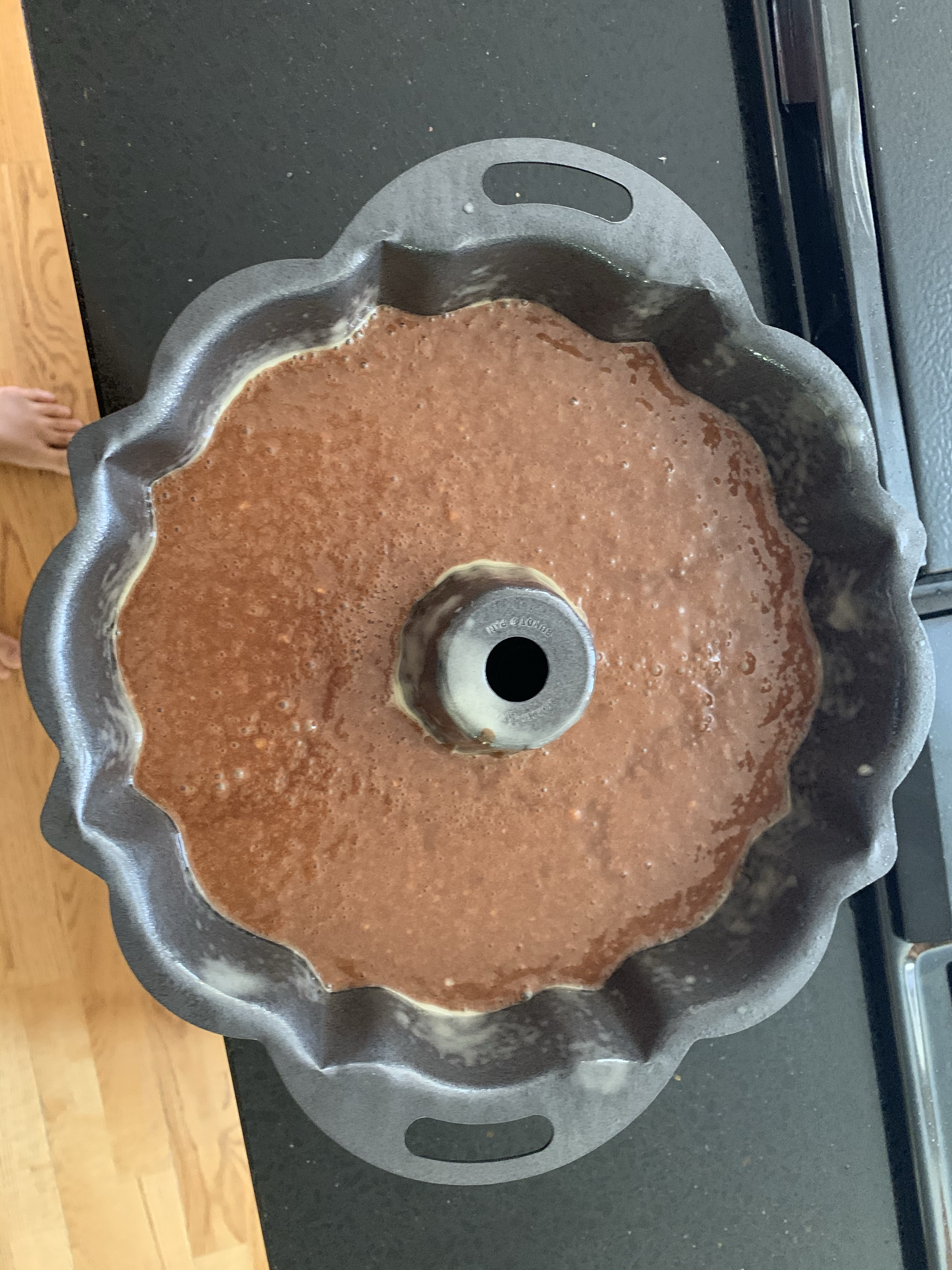
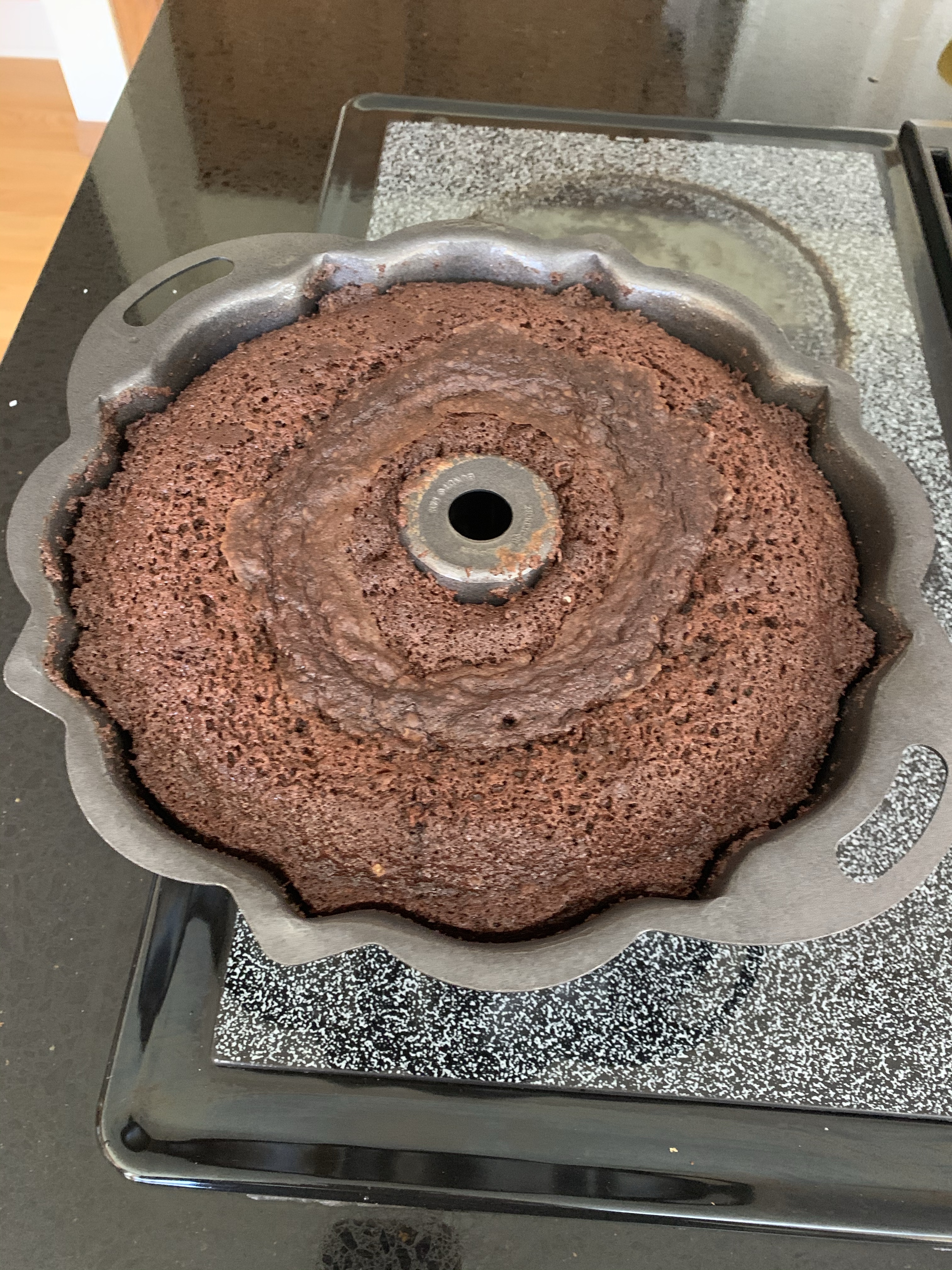
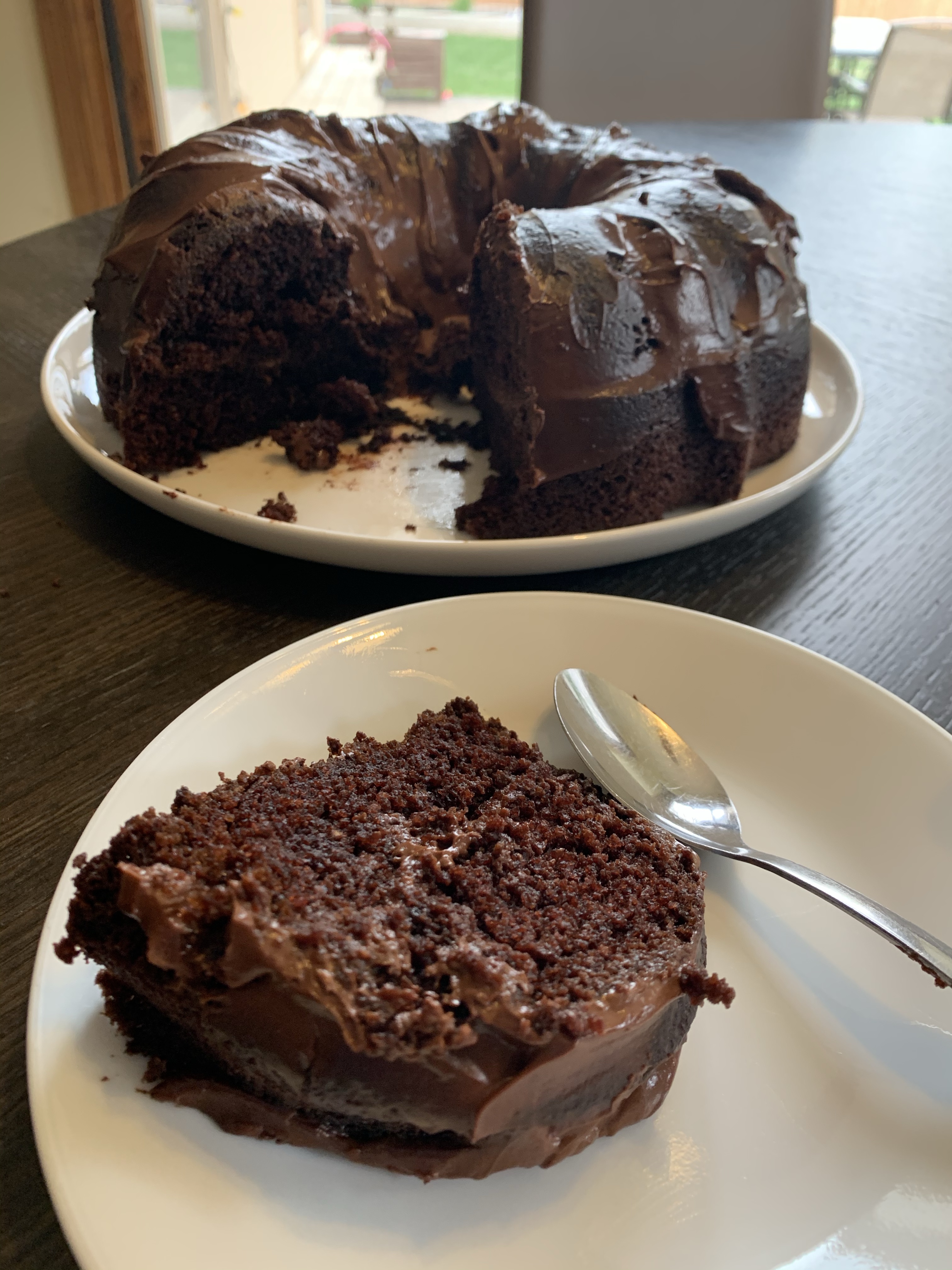
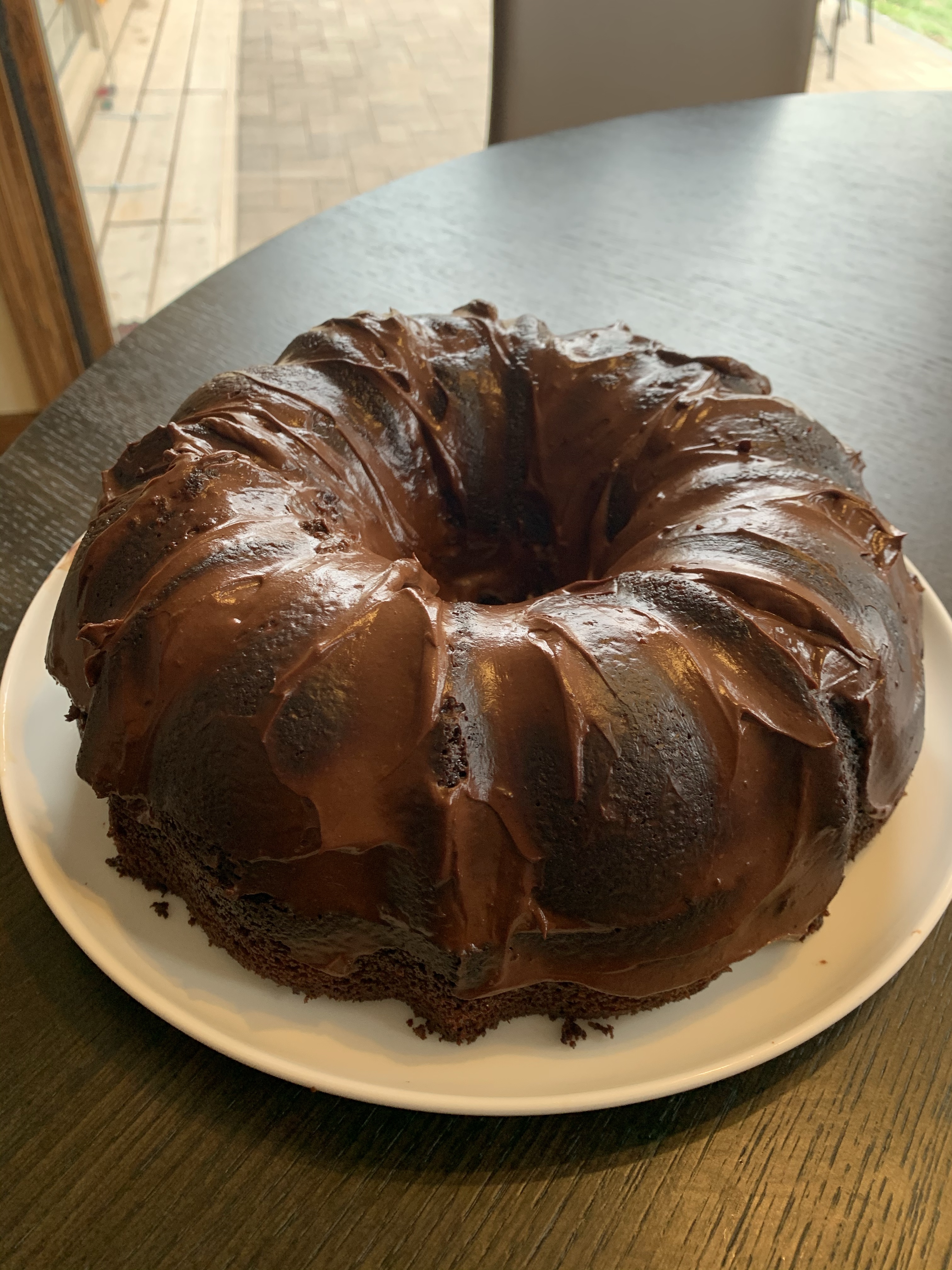
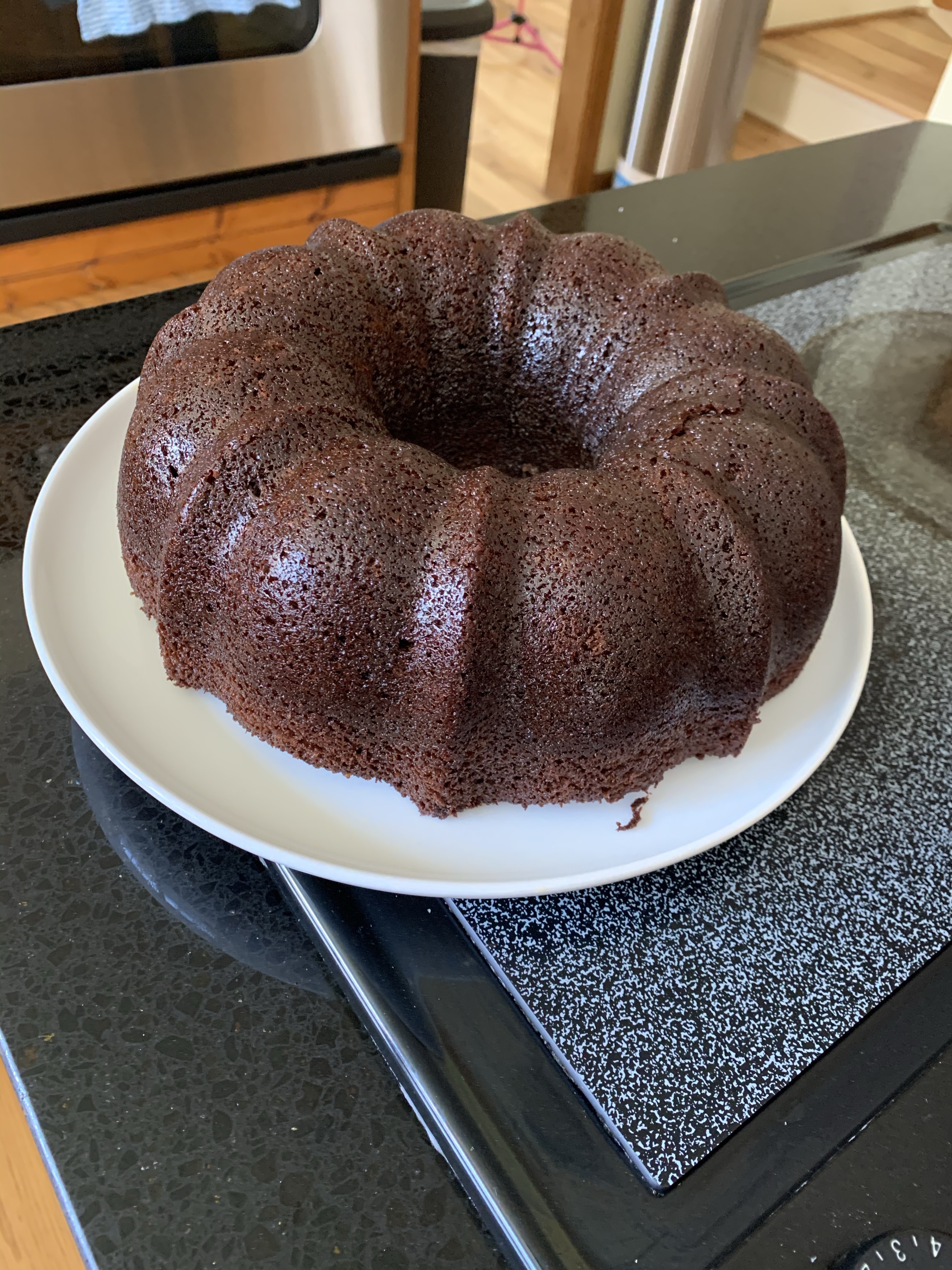
Chocolate Dump it Cake

When your lovely neighbor brings you 10lbs of flour from Costco and leaves it on your porch – you bake a chocolate cake.

This is my go-to chocolate cake recipe modified from Amanda Hesser’s NYT recipe. This cake does not need a mixer- just a wooden spoon. The frosting is outstanding. Feel free to use milk chocolate or add some sugar to the frosting if it is too intense for you.

The recipe just has 3 steps. Well 4 if you count- preheat oven to 375 F as a step. Step 1: Heat 1 stick of butter (8 tbsp), 2 cups of sugar, 1tsp of salt, 4 oz of unsweetened chocolate and 1 cup of coffee or water in a pan till the butter is just melted. Cool to room temperature-ish.  Step 2: Add 1 cup of milk, 1 tsp of vinegar, 1 tsp of vanilla and 2 eggs to the chocolate mixture and whisk till smooth. Step 3: Add to dry ingredients (2 cups all purpose flour, 2 tsp baking soda, 1 tsp baking powder) and mix till all the flour is incorporated. Once it comes together- stop, overmixing will make this cake tough.

Butter and flour a bundt pan and cook for 35 minutes. Cool for 10 and invert. For the frosting, melt about 3/4 cup of semisweet chocolate chips in the microwave in 30 second increments, add 3/4 cup of sour cream (or greek yogurt). I slice the cake in half and fill it and smear the rest on topics .


Tamago Sando (Japanese Egg Sandwich) and Japanese Milk Bread

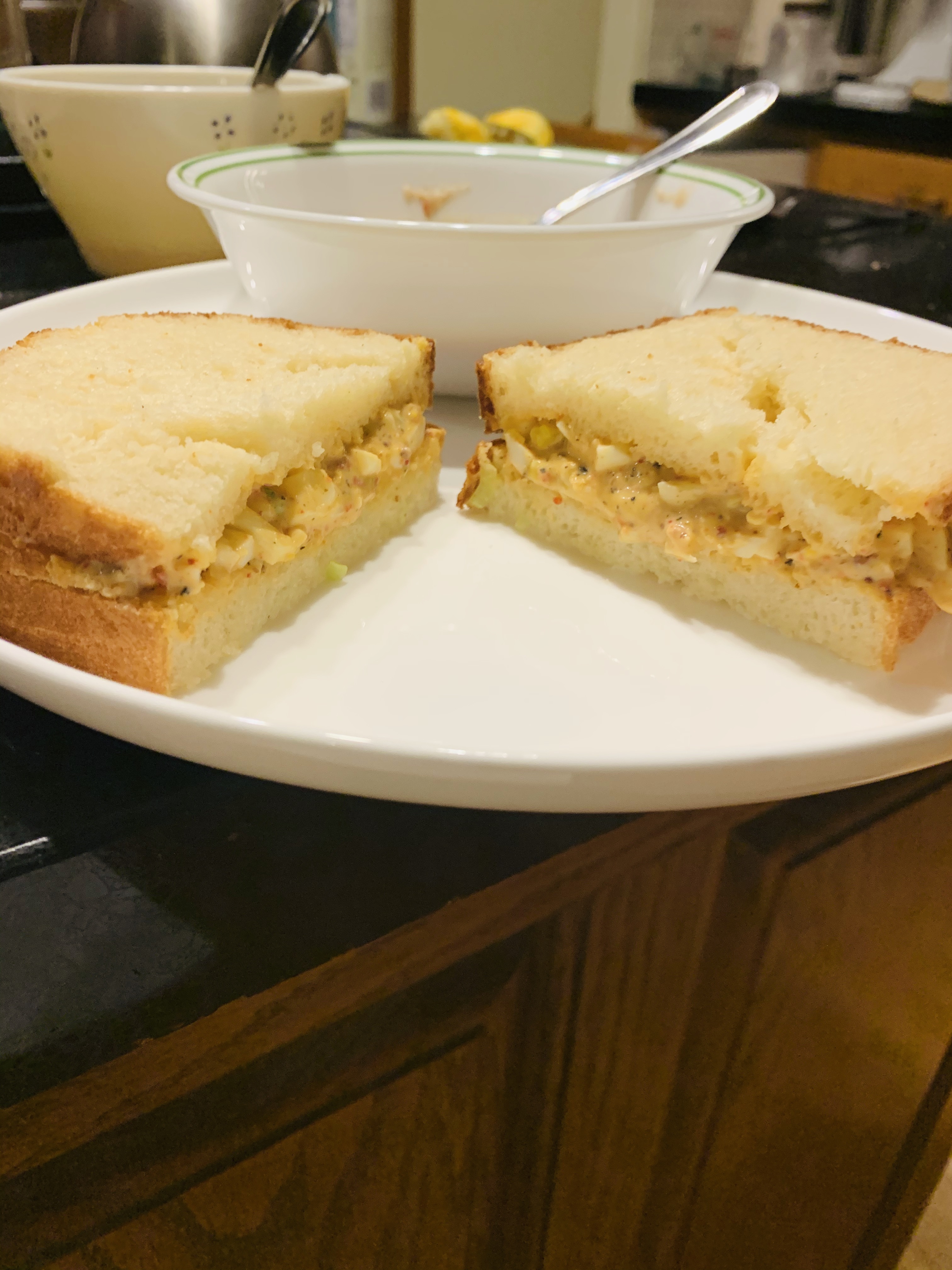
Every expat or immigrant knows that there are dishes you crave when you go back home. Apparently in Japan, it is these egg salad sandwiches- with the softest bread and the simplest of dressings (kewpie mayo, salt and pepper), it is a taste of home for the Japanese. I wouldn’t know- I’ve never been to Japan but I do like egg salad and this was a snowy weekend project.

This recipe is in 2 parts- part one is the egg salad and part 2 is the bread. I have no idea if any of this tasted like the real thing but it was pretty tasty to us.

Egg Salad:

Mayo: All the recipes specifically call for Kewpie Mayo which I could have ordered off amazon or boutht at the Asian store. But instead- I improvised and landed up with something quite delicious (though likely not at all accurate). To 5 tbsp of regular mayonnaise, add 1 tsp of rice wine vinegar, 1 tbsp of sugar, 1 tsp of red pepper flakes, 1 heaped tsp of Dijon mustard, 1 tsp of nutritional yeast (in place of the dashi powder or MSG in most recipes), ½ tsp of granulated garlic and salt and pepper. Increase or decrease the quantities of the additives to your liking till the mayo becomes a delicious dip that  you repeatedly “taste” and then find a cracker to “taste” some more.

Boiled eggs: I love reading about boiling eggs. The serious eats encyclopedia entry on this is one of my favorite food articles. For hard boiled eggs- this works for me- start eggs in cold water and set timer for 15 minutes– the yolks are firm and a beautiful yellow wihtout being rubbery.

Combine chopped eggs with special mayo and 2-3 finely chopped scallions (because Japanese dish).

This is a delicious egg salad- good with any kind of bread but let’s now make the special super soft Japanese bread. Our old friend America’s test kitchen’s bread illustrated book will help us.

Fair warning- this is not a beginner bread, you need to have a fair idea of dough hydration and proofing times. But it isn’t croissants (laminated doughs hate me) –  you should try it. Bread flour is cheap- you can throw away your mistakes.

Start by bringing 3 tbsp of butter to room temperature (soft but not melted). The bread starts with a cooked flour and water paste (a Japanese roux) which leads to a very tender crumb. Whisk 3 tbsp of flour and 1/2 cup water will no lumps remain. Microwave covered, whisking every 20 seconds till the  mixture forms a stiff pudding.

Add the flour paste, 1/2 cup of cold milk and 1 large egg to your stand mixer and use the whisk attachment to blend till smooth (note to self- use blender next time).

Add 1.5 tsp of instant yeast and 11 oz (2 cups) of bread flour. Switch to the dough attachment and knead on low speed for 2-3 minutes till a sticky dough forms. Cover with cling film and rest for 15 minutes.

Add 2 tbsp of sugar and 1.5 tsp kosher salt to dough. Knead for 5 minutes, then add butter 1 tbsp at a time. Knead on medium speed for another 5 minutes till the dough leaves the sides of the bowl but still sticks to the bottom.

Transfer to a floured surface using a bench scraper and form a smooth round ball lightly coated with flour and tuck all the seams under the dough ball. Proof in a lightly greased container for 1-2 hours till doubled in size.

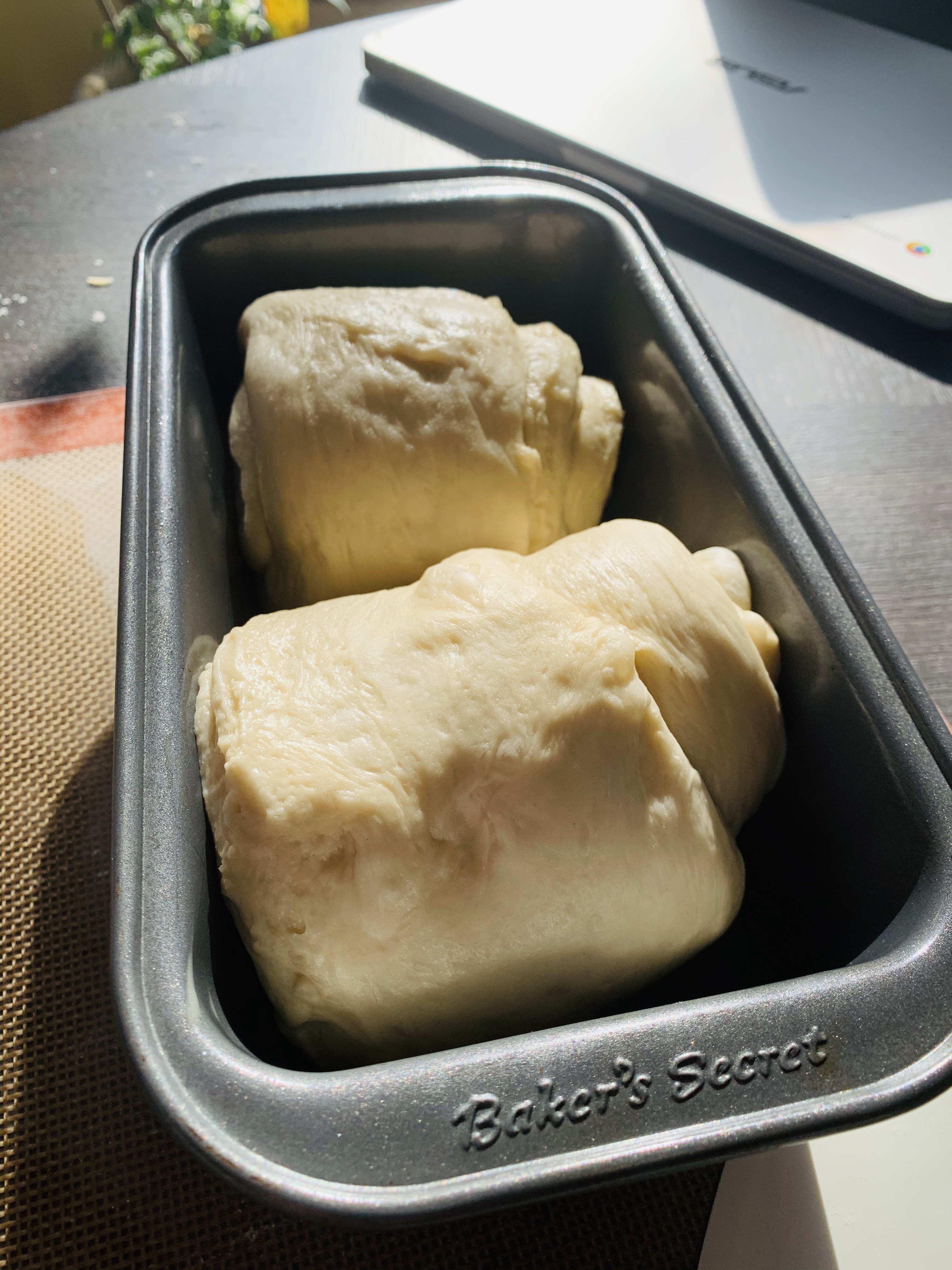
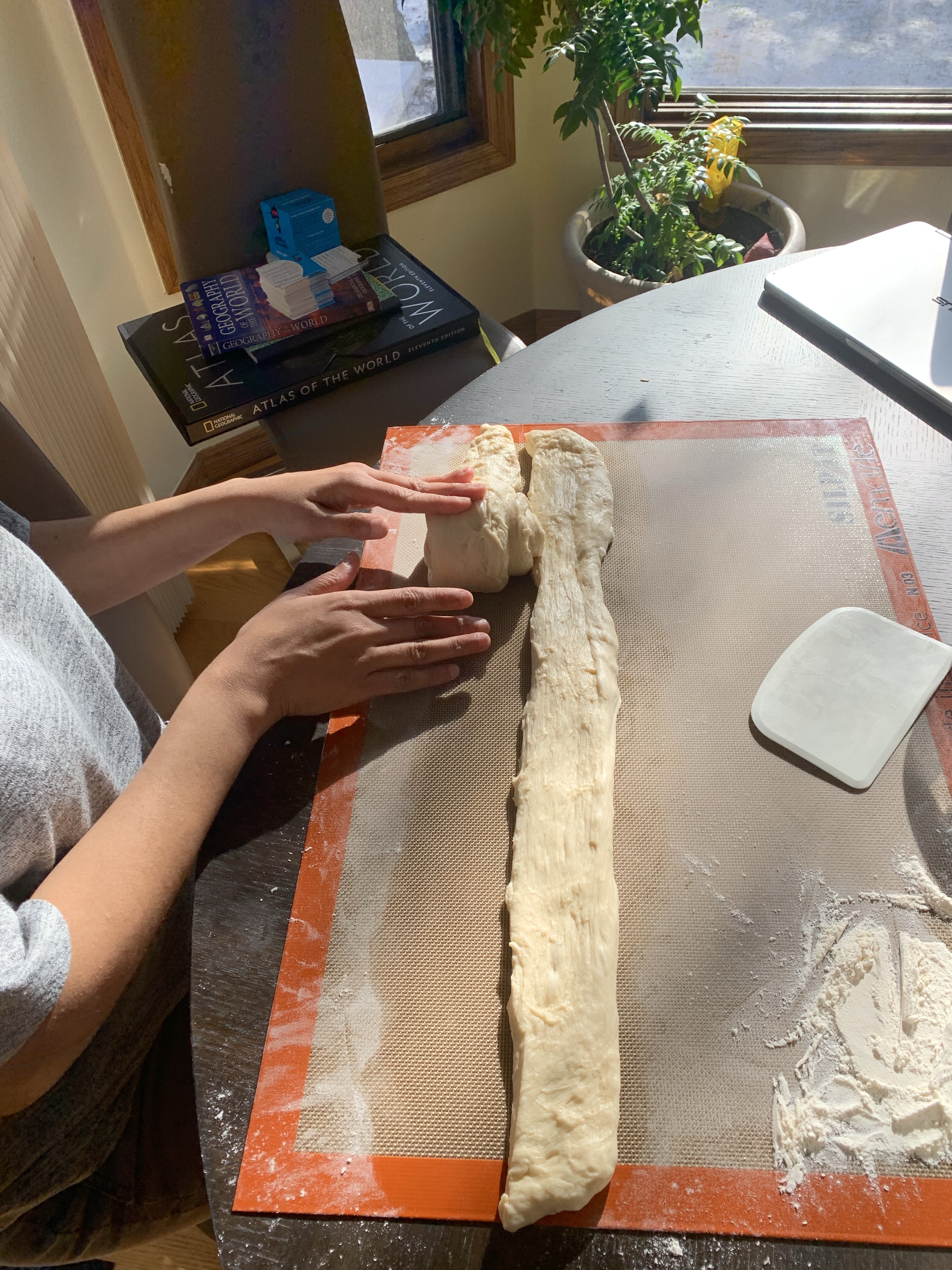
Shaping dough: take dough out onto a large floured area on your countertop ( I use a very large silpat on my countertop for this). Shape into a 24×4 inch rectangle. Now divide the dough using your benchscraper lenghtwise to get 2 rectanges 24×2 inches in size. Start rolling the 2 dough strips into tight spirals and place both side by side into a greased 8.5×4.5 inch loaf pan. Cover with cling film and proof for 1/2-1 hour till the bread rises to the lip of the pan.

Bake at 375 degrees for 30-35 minutes till the bread is a deep golden brown. Cook for 15 minutes, remove from pan and brush all over with  butter. Let bread cool for 2-3 hours before serving.

Slice and pile with egg salad above. Delicious with tomato soup.